
Case study: Recycling waste powers circular economy jobs in British Columbia
Three communities on Vancouver Island are strengthening their local economies through the reuse of construction materials
 CIRCULAR ECONOMY
British Columbia
Across three BC regional districts Synergy Foundation studied, an estimated 20 percent of construction and demolition (C&D) materials are wasted each year. Material exchanges aim to keep valuable materials in use, reducing waste and contributing to a circular economy.
Turning C&D waste into local economic opportunity
Large volumes of C&D materials such as wood, metal, concrete, windows, flooring and cabinets are landfilled each year despite having significant reuse potential and market value. Synergy Foundation commissioned material market studies in three BC regional districts and paired them with community engagement and pilot projects to develop regional exchanges for C&D waste materials. These exchanges demonstrate how local processing, community partnerships and value-add activities can create new jobs, retain material value locally and lay the foundation for a scalable circular economy hub for C&D materials.
C&D materials: lost value and economic impact
- Approximately 33,000 tonnes of C&D material sent to landfill annually
- 25 potential direct jobs from diverting half of C&D materials
- $2.57 million in potential direct economic contribution
- 3 regional districts engaged in material market studies
- 12 businesses participated in Circular Economy Business Assessments
- 3 pilot projects demonstrating local material exchanges and value-add processing
- 140-150 tonnes/year of reclaimed lumber processing capacity enabled
- 8,000 kg of plastic processing in one year, with increased capacity planned
- 12 ongoing material exchanges with local businesses & organizations across all 3 regions
- 196 organizations & businesses engaged
Background
The qathet (qRD), Alberni-Clayoquot (ACRD) and Cowichan Valley (CVRD) regional districts share economic histories rooted in primary resource and manufacturing industries and are navigating economic transition following mill curtailments and broader forest sector shifts. Construction and renovation remain a major economic driver, accounting for roughly 10 percent of the workforce and generating significant volumes of construction and demolition (C&D) waste materials. This sector is both a key source of waste generation and a major opportunity for circular economy solutions that support local jobs and economic resilience.
Barriers to keeping C&D materials in use
C&D materials represent one of the largest and fastest growing waste streams in Canada yet often retain significant value. Synergy Foundation wanted to better understand material flows, market potential and the conditions required to keep materials in use within the qRD, ACRD and CVRD, keeping in mind some key challenges limiting C&D material recovery, which include:
- Limited understanding of the true economic value of C&D waste materials,
- High contamination due to poor source separation practices,
- Fragmented or nonexistent local markets,
- Lack of connections between material generators, processors and end users, and;
- Lack of enabling local policy and incentives.
The ultimate goal was to strengthen local circular economy capacity by increasing the diversion of C&D materials for reuse, recycling and value-added manufacturing.
Building place-based C&D material exchanges
Synergy Foundation received grant funding through the Province of BC’s Rural Economic Diversification and Infrastructure Program (REDIP) to develop circular economy hub strategies for the three regional districts and to better understand how the value of C&D waste materials could be captured locally.
- Three material market studies were commissioned to:
- Quantify recoverable C&D material volumes and value,
- Identify priority materials with near-term market potential,
- Estimate employment impacts, and;
- Highlight barriers such as contamination, lack of sorting and policy gaps.
Multiple in-person engagement sessions brought diverse sectors together including local businesses, social enterprises and artists in order to:
- Establish connections between local businesses,
- Generate ideas and solutions around difficult materials, and
- Validate priorities and next steps to drive further diversion efforts.
Three pilot projects were developed to showcase material exchanges in action.
1. Alberni-Clayoquot Regional District
The Alberni Valley Makerspace and a local construction business demonstrated how recovered C&D materials can support local fabrication and small-scale manufacturing via:
- Processing approximately 8,000 kg of plastic in 2025, with a 2026 goal of 16,000 kg; and
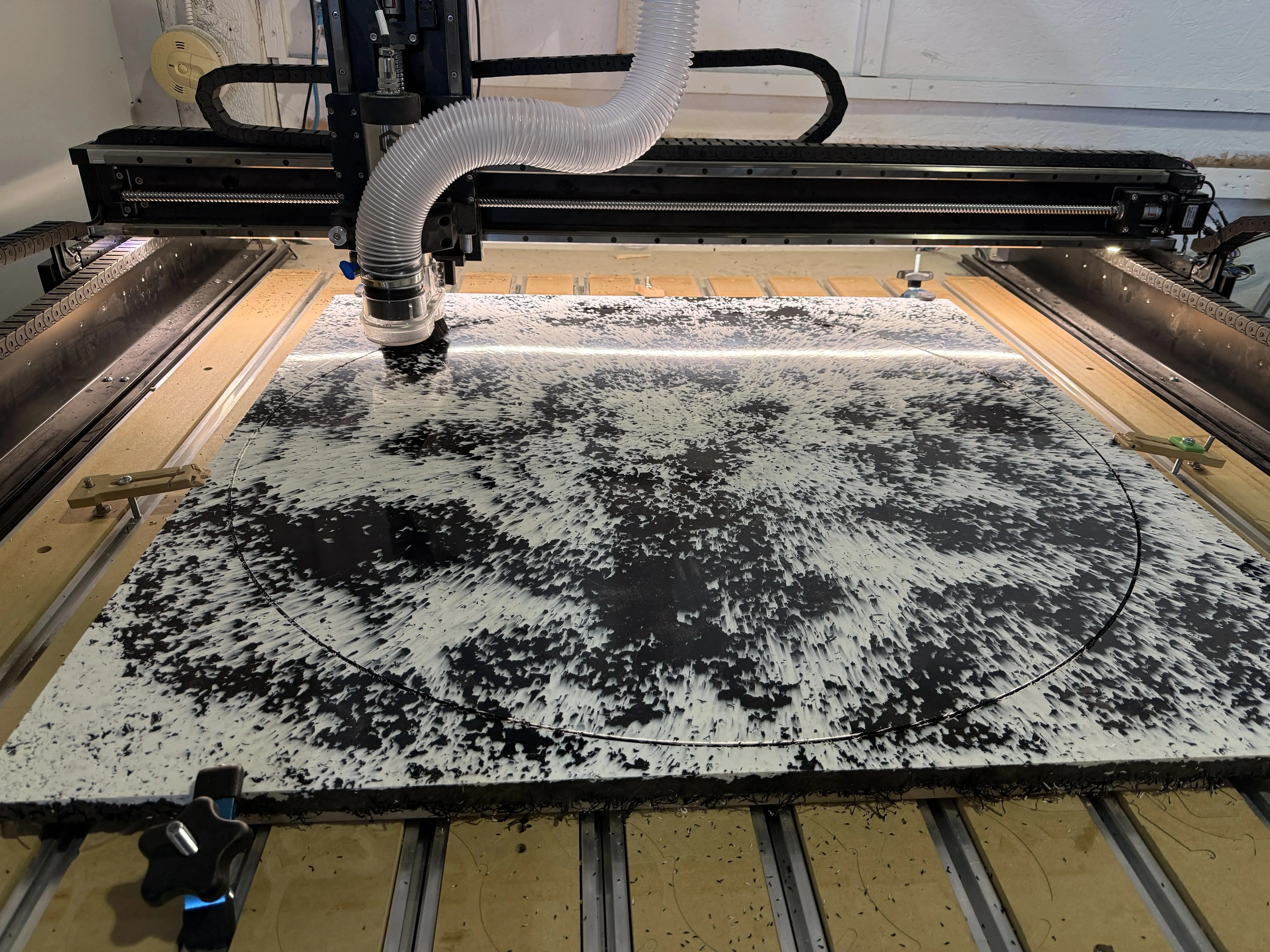
- Value-add activities such as turning construction plastics into 100 percent recycled consumer goods including wetsuit hangers made from recycled plastic culvert.
Recovered plastic culvert being transformed into tabletops at the Alberni Valley Makerspace, January 2026.
2. Cowichan Valley Regional District
The Reuse People of Canada (TRP), a registered charity, worked with DL Bins, a local hauler and waste management company, to enable salvaged wood reuse and processing by:
- Building a consistent supply of affordable reclaimed wood for a range of buyers and end users,
- Developing the capacity to process an estimated 140 to 150 tonnes per year of reclaimed lumber, and;
- Working toward further goals such as bulk buying for contractors, supplying local film productions and performing wood processing such as trimming, grading and quality control.
In addition, TRP’s charitable mandate supports community benefit and inclusion, and it is hiring and training local Indigenous workers for a denailing pilot that will further increase the value of material resale and create local jobs.
3. qathet Regional District
Social enterprise Kindred Rebuild partnered with the qRD, local construction companies and an old mill site to expand their collection and reuse markets via:
- Direct recovery from demolition and construction sites,
- Collaboration with contractors to divert reusable materials, and;
- Sorting and resale for community reuse.
Upcoming plans also include:
- Piloting direct C&D collection from active construction sites,
- Expansion of reuse categories,
- Increasing access to affordable materials, and;
- Offering training and workshops.
Opportunities enabled by regional material exchanges
Together, the studies and engagement established a practical, place-based foundation for developing regional C&D material exchanges that support long-term circular economy outcomes. Importantly, the process is fostering direct connections between material generators and end users. Specific results include:
Environmental
- Reduced landfill disposal of high-value C&D materials (including loads barged to Washington State), and;
- Lower emissions through local reuse and processing.
Economic
- Retention of material value within the local economy, and;
- Job creation in reuse, processing and fabrication.
Social
- Support for charities and social enterprises and their programs,
- Improved access to affordable building materials,
- Skills development and community participation.
“This project marks an exciting step forward in building a more sustainable and resilient local economy. By exploring new opportunities for reuse, innovation and job creation from construction and demolition waste materials we’re not only reducing landfill pressure—we’re investing in our community.”
John Jack, Board Chair, Alberni-Clayoquot Regional District
The benefits
Additional benefits from C&D material exchanges include:
- Keeping money circulating locally rather than exporting waste and importing materials,
- Creating new, place-based jobs,
- Reducing environmental impacts of extraction, transport and disposal,
- Strengthening partnerships between local businesses, community organizations and municipalities, and;
- Reducing risk and uncertainty from external impacts (e.g., tariffs, pandemics) through strengthening local supply chains.
Key learnings for communities exploring material reuse
Across all three regions, engagement with contractors, waste haulers, social enterprises, Indigenous partners, recyclers, artists and makers consistently highlighted the need for:
- Shared coordination,
- Accessible storage and sorting space, and;
- Central or shared facilities and training and upskilling opportunities.
Additional recommendations include:
- Build relationships and foster direct connections to drive implementation.
- Demonstrate economic benefit to industry through practical examples.
- Involve local champions and connectors to engage the community.
- Build project schedules that work for participants: ensure key engagement doesn’t occur during busy summer months for the construction sector and consider early morning sessions.
- Diversify key contributors: think outside the box regarding who should be part of the project.
- Prioritize in-person engagement and personal relationships where possible.
Contact
Tai Uhlmann, Senior Project Manager
Synergy Foundation
tai@synergyfoundation.ca
Michael Moore, the Alberni Valley Makerspace
mmoore@albernimakerspace.ca
Beverley Dondale, The Reuse People of Canada
bdondale@trpcanada.org
Todd Clarke, Kindred Rebuild
tclarke@inclusionpr.ca
Related resources
- Case study: A framework for advancing circular economy in rural communities
- Case study: Empowering a local workforce in Port Alberni through a circular economy
- Circular Hubs Best Practices report
- Market studies reports:
- Inter-regional Synthesis report
Want to explore all GMF-funded projects? Check out the Projects Database for a complete overview of funded projects and get inspired by municipalities of all sizes, across Canada.
Related Resources
See All
Guide
 Sustainable affordable housing
 Energy
Sustainable affordable housing
Energy
Driving local impact in Quebec
Communities across Quebec are investing in sustainable infrastructure, housing, waste management and transportation. Discover how these upgrades could benefit your community, along with additional tools and resources to help you deliver a local project of your own.
Webinar recording
 Local energy generation
 Waste
Waste
Local energy generation
Waste
Webinar recording: Advancing climate goals with organic waste-to-energy
Watch our webinar to learn how municipalities can turn food scraps and other organic waste into renewable energy and natural fertilizer, and access funding opportunities.
Guide
Local energy generation
Waste
Local energy generation
Waste
Factsheet: Capturing emissions and turning waste into energy with anaerobic digestion
Learn how anaerobic digestion turns food waste into energy, biogas and renewable natural gas—to cut costs, divert organics and reduce landfill emissions.
Tool
 Municipal buildings
Energy
Municipal buildings
Energy
Municipal buildings
Energy
Supporting local success stories across the Canadian Prairies
Discover how GMF funding is helping communities with unique local contexts reach their economic, social and climate goals.
Guide
Municipal buildings
Waste
Municipal buildings
Waste
Accelerating the transition to a circular economy: Material reuse for a net-zero future
Learn how circular construction reduces waste, lowers emissions and saves costs while strengthening communities and combating climate impact. Discover CERIEC’s solutions today.
Guide
Municipal buildings
 Land Use
Municipal buildings
Land Use
Factsheets: Working with nature to improve infrastructure project outcomes
Learn how you can integrate nature-based solutions into your community’s infrastructure project planning
Webinar recording
Municipal buildings
Energy
Municipal buildings
Energy
Webinar recording: Accelerate your community’s net-zero transformation with new GMF funding
Watch our webinar to discover how GMF’s new funding can help you upgrade infrastructure and reduce local GHG emissions.
Webinar recording
Municipal buildings
 Energy | Housing
Municipal buildings
Energy | Housing
Webinar recording: How to get a project started, tips for small francophone communities
If you’re a small francophone municipality looking to develop sustainability projects and access funding, watch this webinar to learn how others overcame common challenges.
Webinar recording
Waste
Waste
Webinar recording: Net-Zero Circularity: Procurement
Watch this webinar recording to see how circular procurement can help put the principles of a circular economy into action.
Guide
Waste
Waste
Resources: Strengthening your municipality’s circular economy initiatives
Find case studies, exercises and worksheets to help your municipality reduce waste and strengthen its circular economy initiatives.
Webinar recording
Waste
Waste
Webinar recording: How to start the conversation about circular economies in your municipality
Webinar recording
Energy
Energy
Webinar recording: The 5 keys to a green municipal project business case
Watch this webinar recording and discover the five critical focus areas you need to address to get your project started, from financing and partnerships to integrating a triple-bottom-line approach.
Tool
Waste
Waste
Circular Cities & Regions Initiative
Interested in learning more about how the circular economy can come to life in cities and regions? Review the CCRI webinar recordings featuring speakers from leading organizations and global cities.
Webinar recording
Energy | Housing
Energy | Housing
Webinar recordings: Best practices in municipal sustainability
How are cities and communities of all sizes tackling their environmental challenges? Find out from our five-part webinar series on innovations and opportunities in municipal energy, waste, water, transportation and land use initiatives.
Report
Waste
Waste
Report: Solid waste management in Canadian municipalities
Expanding responsibility for producers to include the post-consumer stage of their products is a key solution for financial and environmental sustainability in the waste sector.
Webinar recording
Waste
Waste
Webinar recordings: Plastic waste management solutions for Canadian municipalities
Watch our webinar recordings to see how your Canadian municipality can reduce and better manage your plastic waste through innovative solutions and approaches.
Guide
Waste
Waste
Guide: 2018 Sustainable Communities Awards project guide: Waste
Learn how to implement the best practices and strategies used by Kitimat-Stikine, BC, our 2018 Sustainable Communities Awards waste winner.
Guide
Waste
Waste
Six sustainability ideas that have gone mainstream in Canada: Article series
In a series of six articles, we explore inspiring projects and sustainability solutions being implemented in cities and towns of all sizes across Canada.
Guide
Waste
Waste
Guide: Sustainable Neighbourhood Development
This guide, Sustainable Neighbourhood Development: Practical Solutions to Common Challenges, is designed to help you re-imagine your municipality's approach to planning, development and regulation.
Webinar recording
 Transportation
Transportation
Webinar recording: Solutions to municipal sustainability challenges
Watch our webinar recordings to learn how you can address sustainability challenges in waste management, transportation and asset management in your municipality.