
Case study: A framework for advancing circular economy in rural communities
How local governments can use construction and demolition materials to build economic resilience and address rural barriers while unlocking local opportunity
 CIRCULAR ECONOMY
British Columbia
Summary
This case study presents a practical framework that rural local governments can adopt to implement circular economy practices focused on construction and demolition (C&D) waste materials. Designed for communities facing economic transition, geographic isolation and limited staff and infrastructure capacity, the framework combines material market studies, in‑person engagement and community‑driven pilots to turn local waste streams into economic assets. By strengthening material exchanges and value‑add processing, rural municipalities can reduce costs, create jobs and improve long‑term economic resilience.
Highlights
This step‑by‑step approach is tailored to rural local governments and adaptable across different rural geographies and scales.
- Use material market studies to understand the C&D sector, identify opportunities in the circular economy and assess regional gaps.
- Foster community partnerships and diverse in-person engagement to validate data, identify priorities and support reuse locally.
- Leverage existing community assets rather than building from scratch.
- Support local jobs, social enterprises and small businesses.
Background
Why Rural Communities Need a Different Approach
Many rural communities have historically had resource‑based economies. As these industries decline or consolidate, communities are left navigating economic transition with limited tools and capacity. In rural contexts, success depends on flexibility, relationship‑building and making the most of existing local assets.
Rural local governments seeking to advance circular economy initiatives often encounter:
- Small and inconsistent material volumes/markets,
- Lost economic value in wasted construction, renovation and demolition activities,
- High transportation and disposal costs,
- Limited local processing infrastructure,
- Capacity constraints amongst municipal staff,
- Economic vulnerability following industry closures, and;
- Lack of policy.
The challenge: Structural barriers in rural circular economy work
Synergy Foundation created a framework it describes as a community‑first pathway to circular economy. It consists of three steps:
1. Understand local barriers and opportunities
- Start with material market studies that are right‑sized for rural contexts. These studies help communities:
- Identify which C&D materials are realistically recoverable and have financial value,
- Understand local and regional market potential,
- Quantify economic and employment opportunities,
- Understand existing transferable skills and training gaps, and
- Assess regional gaps in policy that could support or hinder material reuse.
- This data builds confidence for councils, staff and partners.
2. Design with the community, not for it
Rural communities benefit from in‑person engagement. This framework emphasizes:
- Listening to what community members and businesses say they need,
- Working through community connectors who already hold trust, and
- Validating assumptions before designing solutions.
This step ensures initiatives respond to real demand, not abstract goals.
3. Build on what already exists
Rather than creating new systems from scratch, local governments should:
- Leverage social enterprises, charities, makerspaces and small businesses,
- Assess the potential of unused or underutilized public infrastructure or spaces,
- Support partnerships that align economic, environmental and social goals, and;
- Identify pilot projects that can grow over time.
The following examples illustrate how rural and remote communities can advance circular economy outcomes by supporting practical, low-cost initiatives that build on existing community assets and relationships.
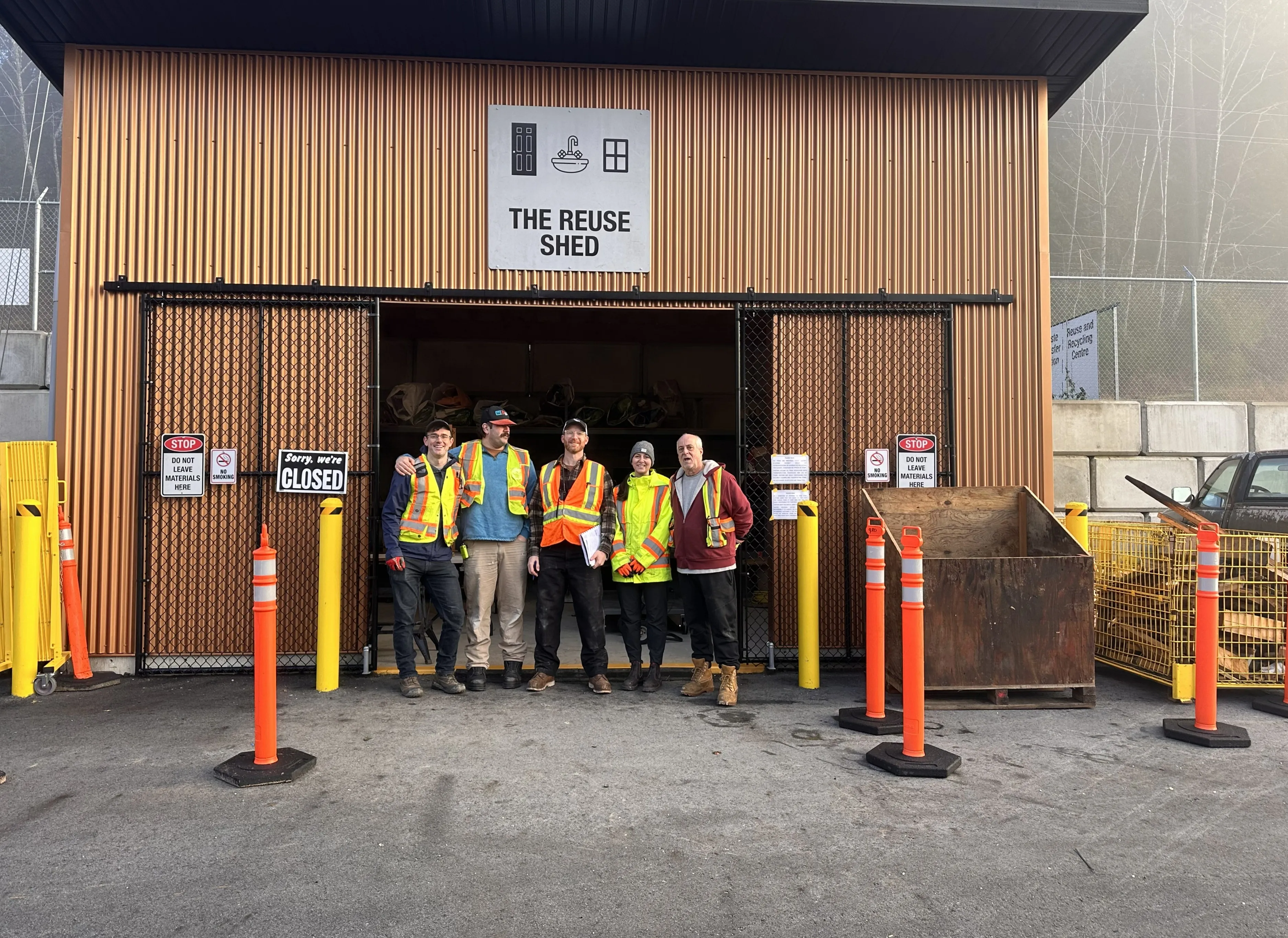
qathet Regional District Reuse Shed with Kindred Rebuild, March 2026.
1. Reuse sheds as a low-cost, scalable pilot/hub
Reuse sheds at transfer stations, landfills or other key locations offer a practical starting point for communities looking to pilot C&D material reuse without significant upfront investment.
Example in practice: qathet Regional District (qRD)
- qRD partnered with social enterprise Kindred Rebuild to establish a reuse shed offering a space at the local transfer station to recover reusable materials and diverts from landfill/disposal.
- Materials are sorted, stored and offered free to the community, improving access to affordable building materials.
Local government:
- Identified reuse as a priority in the community,
- Supported site access and integration within existing waste management operations, and
- Enabled a partnership with a trusted local organization to support operations.
2. Small-scale processing to increase material value and job creation
Material processing (e.g., denailing, sorting, grading) significantly increases the reuse potential and market value of salvaged materials while supporting local inclusive employment.
Example in practice: Cowichan Valley Regional District
- The Reuse People of Canada, a registered charity, partnered with a local hauler to divert and reclaim lumber destined for hog fuel or landfill.
- Salvaged wood is denailed and sorted, creating local jobs and producing a consistent reclaimed lumber supply for end users.
Local government:
- Promoted services and diversion opportunities in the community.
3. In-person engagement to build material exchanges
In-person engagement consistently highlighted opportunities to connect material generators with processors and end users.
Cross-regional insights:
- Relationship-building enabled immediate, low-cost material exchanges without new infrastructure.
- Community partnerships, value-add activities and local processing can support new jobs, keep materials in use locally while retaining their value and create a circular economy hub for C&D materials.
The framework is designed to respond to challenges with realistic solutions. For example:
- Transportation infrastructure limitations → Build on existing infrastructure to incorporate more backhauling services.
- Geographic isolation and transportation costs → Focus on local reuse and value‑add rather than export‑dependent recycling.
- Limited municipal capacity → Use partnerships and pilots to extend staff capacity.
- Market uncertainty → Start small, test assumptions, build pilot projects and scale gradually.
- Grant/funding cycles → Invest in relationships and ongoing presence, not one‑time studies.
The results
Key outcomes from the framework
Economic
- Reduced reliance on costly waste export,
- Local job creation through reuse and processing,
- Retention of material value in rural economies, and;
- Local supply chain resilience from external impacts such as tariffs.
Environmental
- Increased diversion of reusable C&D materials, and;
- Reduced emissions from long‑distance transport.
Social/governance
- Stronger partnerships across sectors, and;
- Alignment with community‑identified priorities.
“What makes the Circular Hubs project so compelling is its community-driven approach. By grounding circular economy solutions in local engagement and real-world pilots, it ensures that economic and environmental benefits are felt locally and sustainably.”
Jason Kouwenhoven, CPA, Manager of Environmental Services, qathet Regional District
The benefits for rural communities
This framework helps rural communities move from reactive waste management to proactive economic development. It supports affordability, strengthens local businesses and builds resilience during periods of transition. By keeping materials, money and skills local, communities gain greater control over their economic future.
Lessons learned
- Invest in a local connector, someone already immersed in the community.
- Prioritize in‑person engagement and networking whenever possible.
- Ensure outreach and engagement reaches industry, social enterprise, innovators, artists and makers.
- Avoid “pop‑in, pop‑out” approaches; continuity matters.
- Start with existing assets and amplify the work people are already doing.
- Pilot before scaling to reduce risk.
- Be flexible.
Next steps
In the qathet Region, early action is underway through an emerging pilot that illustrates how rural communities can begin advancing circular economy outcomes using existing relationships and infrastructure.
Kindred Rebuild, a local social enterprise, is diverting materials directly from an industrial site, strengthening local partnerships and increasing material reuse in the community. The pilot is focused on:
- Diversion of high value materials directly from an industrial site, keeping them in local circulation.
- Using existing on site storage infrastructure to enable higher material recovery, temporary storage, sorting, and redistribution through reuse sheds and retail channels.
- Expanding local material availability, with the potential to reduce reliance on sourcing trips from the Lower Mainland over time.
- Piloting direct material collection with a construction business, testing how recovery can be integrated into routine construction workflows without new infrastructure.
As experience grows, lessons from this pilot can inform future collaboration, targeted small scale processing, and policy development that better reflects rural realities. Further examples will be shared as this work evolves.
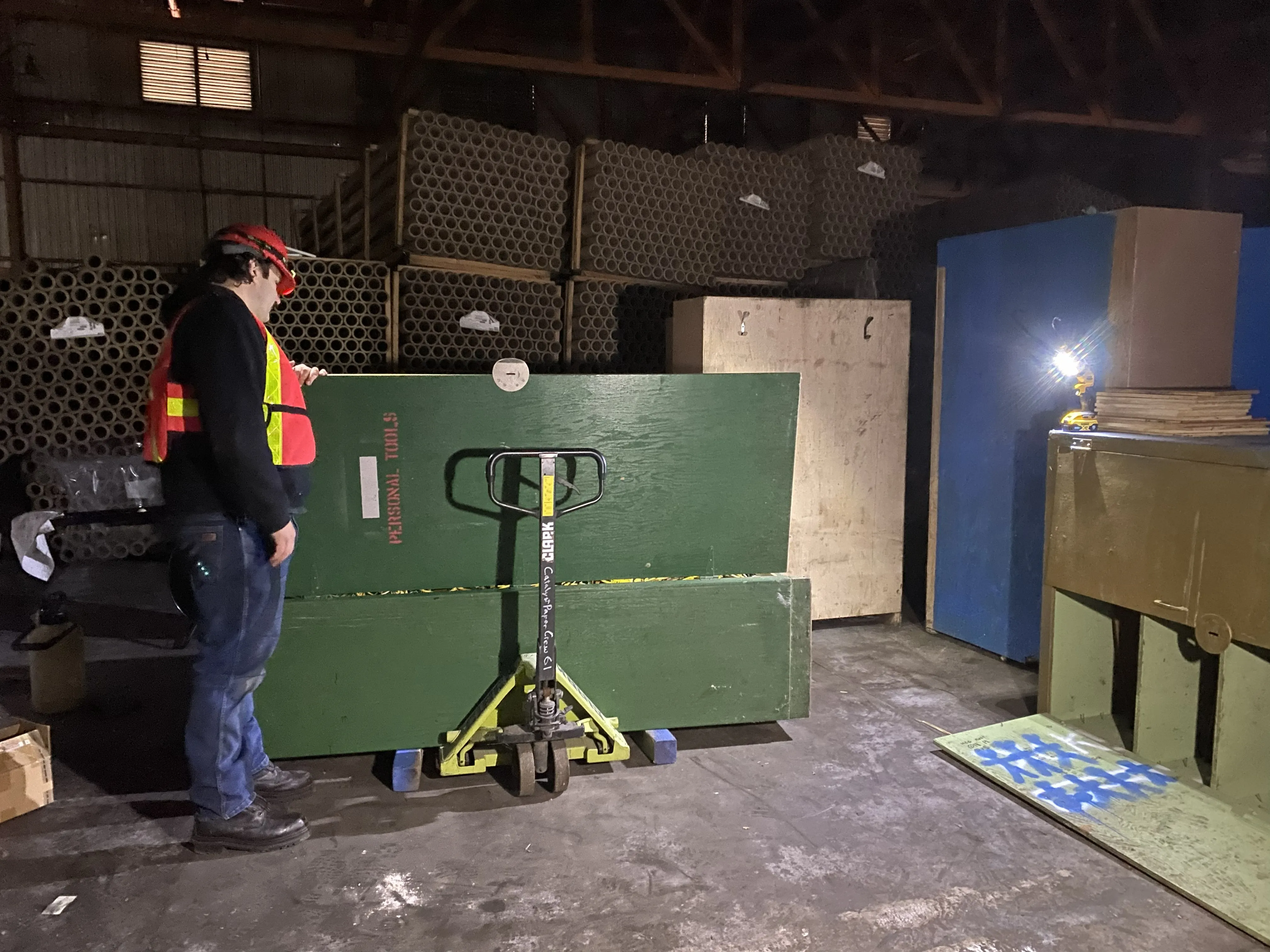
Kindred Rebuild collecting excess materials from closed qathet mill, March 2026.
Contact
Tai Uhlmann, Senior Project Manager
Synergy Foundation
tai@synergyfoundation.ca
Related resources
Want to explore all GMF-funded projects? Check out the Projects Database for a complete overview of funded projects and get inspired by municipalities of all sizes, across Canada.
Related Resources
See All
Guide
 Sustainable affordable housing
 Energy
Sustainable affordable housing
Energy
Driving local impact in Quebec
Communities across Quebec are investing in sustainable infrastructure, housing, waste management and transportation. Discover how these upgrades could benefit your community, along with additional tools and resources to help you deliver a local project of your own.
Webinar recording
 Local energy generation
 Waste
Waste
Local energy generation
Waste
Webinar recording: Advancing climate goals with organic waste-to-energy
Watch our webinar to learn how municipalities can turn food scraps and other organic waste into renewable energy and natural fertilizer, and access funding opportunities.
Guide
Local energy generation
Waste
Local energy generation
Waste
Factsheet: Capturing emissions and turning waste into energy with anaerobic digestion
Learn how anaerobic digestion turns food waste into energy, biogas and renewable natural gas—to cut costs, divert organics and reduce landfill emissions.
Tool
 Municipal buildings
Energy
Municipal buildings
Energy
Municipal buildings
Energy
Supporting local success stories across the Canadian Prairies
Discover how GMF funding is helping communities with unique local contexts reach their economic, social and climate goals.
Guide
Municipal buildings
Waste
Municipal buildings
Waste
Accelerating the transition to a circular economy: Material reuse for a net-zero future
Learn how circular construction reduces waste, lowers emissions and saves costs while strengthening communities and combating climate impact. Discover CERIEC’s solutions today.
Guide
Municipal buildings
 Land Use
Municipal buildings
Land Use
Factsheets: Working with nature to improve infrastructure project outcomes
Learn how you can integrate nature-based solutions into your community’s infrastructure project planning
Webinar recording
Municipal buildings
Energy
Municipal buildings
Energy
Webinar recording: Accelerate your community’s net-zero transformation with new GMF funding
Watch our webinar to discover how GMF’s new funding can help you upgrade infrastructure and reduce local GHG emissions.
Webinar recording
Municipal buildings
 Energy | Housing
Municipal buildings
Energy | Housing
Webinar recording: How to get a project started, tips for small francophone communities
If you’re a small francophone municipality looking to develop sustainability projects and access funding, watch this webinar to learn how others overcame common challenges.
Webinar recording
Waste
Waste
Webinar recording: Net-Zero Circularity: Procurement
Watch this webinar recording to see how circular procurement can help put the principles of a circular economy into action.
Guide
Waste
Waste
Resources: Strengthening your municipality’s circular economy initiatives
Find case studies, exercises and worksheets to help your municipality reduce waste and strengthen its circular economy initiatives.
Webinar recording
Waste
Waste
Webinar recording: How to start the conversation about circular economies in your municipality
Webinar recording
Energy
Energy
Webinar recording: The 5 keys to a green municipal project business case
Watch this webinar recording and discover the five critical focus areas you need to address to get your project started, from financing and partnerships to integrating a triple-bottom-line approach.
Tool
Waste
Waste
Circular Cities & Regions Initiative
Interested in learning more about how the circular economy can come to life in cities and regions? Review the CCRI webinar recordings featuring speakers from leading organizations and global cities.
Webinar recording
Energy | Housing
Energy | Housing
Webinar recordings: Best practices in municipal sustainability
How are cities and communities of all sizes tackling their environmental challenges? Find out from our five-part webinar series on innovations and opportunities in municipal energy, waste, water, transportation and land use initiatives.
Report
Waste
Waste
Report: Solid waste management in Canadian municipalities
Expanding responsibility for producers to include the post-consumer stage of their products is a key solution for financial and environmental sustainability in the waste sector.
Webinar recording
Waste
Waste
Webinar recordings: Plastic waste management solutions for Canadian municipalities
Watch our webinar recordings to see how your Canadian municipality can reduce and better manage your plastic waste through innovative solutions and approaches.
Guide
Waste
Waste
Guide: 2018 Sustainable Communities Awards project guide: Waste
Learn how to implement the best practices and strategies used by Kitimat-Stikine, BC, our 2018 Sustainable Communities Awards waste winner.
Guide
Waste
Waste
Six sustainability ideas that have gone mainstream in Canada: Article series
In a series of six articles, we explore inspiring projects and sustainability solutions being implemented in cities and towns of all sizes across Canada.
Guide
Waste
Waste
Guide: Sustainable Neighbourhood Development
This guide, Sustainable Neighbourhood Development: Practical Solutions to Common Challenges, is designed to help you re-imagine your municipality's approach to planning, development and regulation.
Webinar recording
 Transportation
Transportation
Webinar recording: Solutions to municipal sustainability challenges
Watch our webinar recordings to learn how you can address sustainability challenges in waste management, transportation and asset management in your municipality.