
Case study: Empowering a local workforce in Port Alberni through a circular economy
How a community-led workforce development plan is supporting workers impacted by mill closures through circular economy training and job pathways
 CIRCULAR ECONOMY
British Columbia
Background
In Port Alberni, BC, the closure of the largest forestry mills—long-standing anchors of employment and economic activity—has had deep and far-reaching impacts on workers, families and the broader community. In addition, Port Alberni’s workforce faces pressures of lower-than-average labour force participation, with relevant factors including:
- An aging workforce (median age of 50),
- Lower educational attainment (only 11 percent of the population holds a bachelor’s degree compared to 29 percent provincially),
- Lower medium income, and;
- Structural barriers to participation such as access to transportation and child care.
The circular economy, which represents a $6.1 trillion opportunity to Canada by 2030, is one potential source of new jobs for these underemployed workers.
The challenge
Port Alberni’s workforce has deep expertise in mechanical repair, equipment operation, fabrication, logistics and natural resource management—skills that can directly transfer into a circular economy. Yet, as mill closures reshaped the local labour market, many workers were left without clear pathways to apply this experience in new and sustainable industries. Workers directly and indirectly impacted by mill curtailments need training and upskilling to access current job opportunities and help build new ones in a shifting local economy. Synergy Foundation wanted to find solutions to help this transfer happen.
The challenge was not a lack of skills or motivation, but the absence of inclusive, community based pathways to help workers transition into sustainable, future focused roles. The urgency to diversify the local economy alongside longstanding structural barriers – including access to transportation, childcare, affordable housing, and limited access to post-secondary education - highlighted the need for short-term, place-based funded training and paid training with supports that could connect displaced workers to immediate job opportunities while supporting a more resilient, future-oriented workforce.
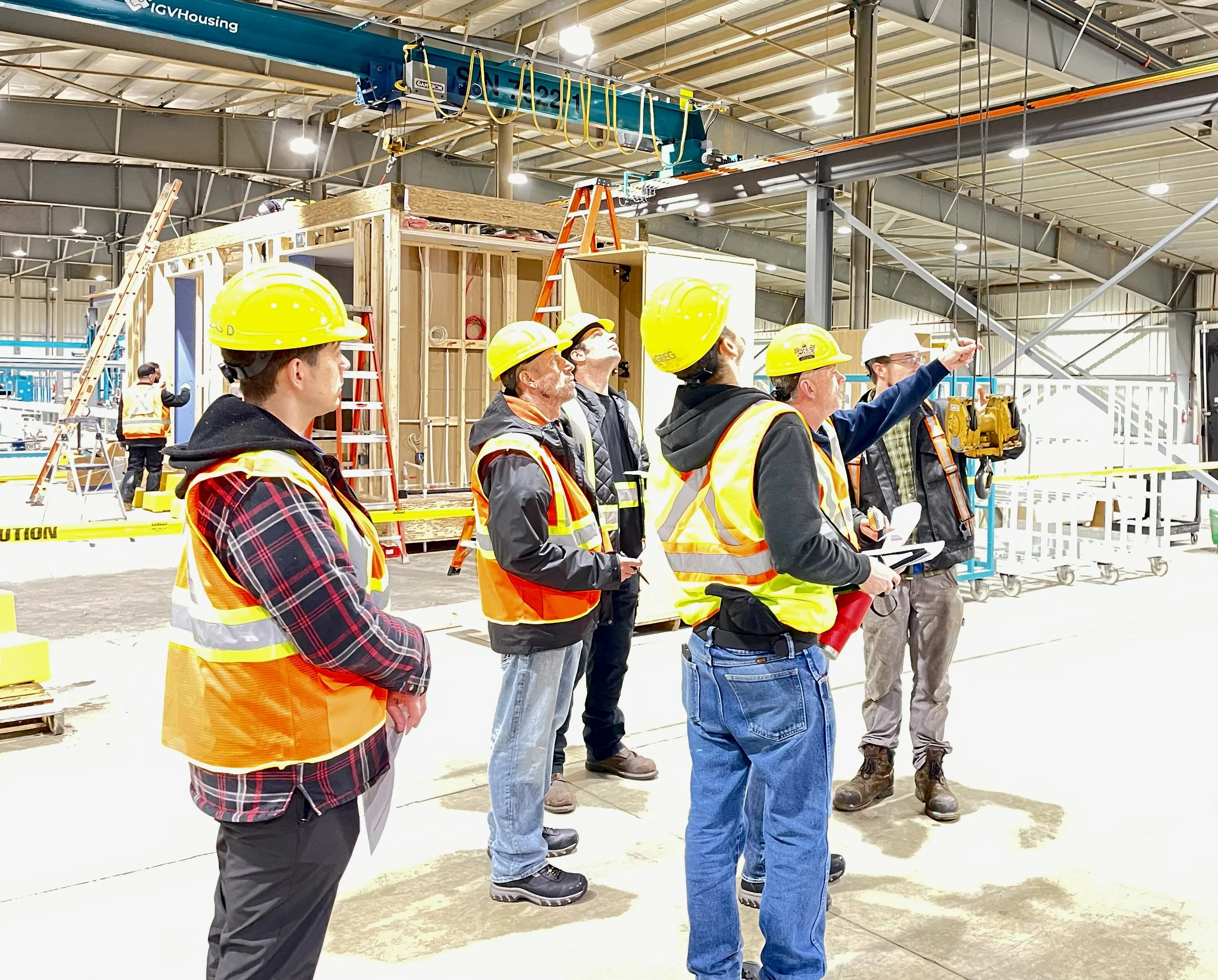
Green Building Foundations, Manufacturing and IT Course, March 2026.
The approach
With funding from the Canada Retraining and Opportunities Initiative, Synergy Foundation undertook a project to assess Port Alberni’s evolving workforce and explore emerging circular economy sectors.
The project draws on key contributor engagement from:
- Local employers and business owners,
- First Nations and Indigenous-led organizations,
- Post-secondary institutions and training providers,
- Workforce development and employment service organizations,
- Sector specialists and industry associations, and;
- Municipal and regional economic development and sustainability representatives.
Components include:
1. Labour market study and workforce development plan
Shaped by the voices of local key contributors, this concrete action plan names leads and partners, defines success and sets timelines, budgets and funding opportunities.
2. Funded training and work placements
Four community-tailored circular economy skills training programs offered by local providers (North Island College and Coastal Restoration Society) focus on hands-on learning, with wraparound participant supports.
“The training has been really positive. We’ve gained hands-on experience, earned new certifications, and built confidence along the way. It feels good to invest in myself and be part of work that supports a circular economy in our community.”
- Green Building Fundamentals: Manufacturing & IT Training Participant, April 2026
The results
The development plan created through this project is a phased 10-year strategy to build a circular economy workforce that will transform Port Alberni into a hub for green building, marine innovation, environmental restoration and regenerative tourism.
Project results include:
- Identified four priority training pathways aligned with strong local demand, particularly in construction and sustainability‑related projects:
- Green building fundamentals: deconstruction and salvage,
- Green building fundamentals: manufacturing and IT,
- Maritime industry and environmental restoration and remediation,
- Tourism operator sustainability.
- Established a steering committee to guide program design and ensure community ownership.
- Designed training programs that are short‑term, practical and directly connected to employment opportunities.
- Prioritized Indigenous partnerships and knowledge to support culturally relevant and inclusive workforce development.
Anticipated outcomes during the 2026 training courses include:
- 48 individuals trained
- 15 individuals placed into new jobs
“When we invest in community-based initiatives, we invest in people. By supporting workers and employers through times of transition, we strengthen local resilience and empower communities to create solutions for the future. Projects like this, which prioritize green innovation and local capacity, help future-proof our communities while advancing our collective environmental goals.” Patty Hajdu, Minister of Jobs and Families and Minister responsible for the Federal Economic Development Agency for Northern Ontario
Lessons learned
Some recommendations for similar projects include:
- Partner with local businesses with direct opportunities for employment.
- Work with businesses to understand skills needed to train future workforce.
- Provide financial incentives and supports for trainee participation and retention.
- In-person engagement is essential; more than 60 people attended one session.
- Put together a steering committee that represents the broader community to ensure outcomes reflect community priorities.
Contact
Tai Uhlmann, Senior Project Manager
Synergy Foundation
tai@synergyfoundation.ca
Related resources
Want to explore all GMF-funded projects? Check out the Projects Database for a complete overview of funded projects and get inspired by municipalities of all sizes, across Canada.
Related Resources
See All
Guide
 Sustainable affordable housing
 Energy
Sustainable affordable housing
Energy
Driving local impact in Quebec
Communities across Quebec are investing in sustainable infrastructure, housing, waste management and transportation. Discover how these upgrades could benefit your community, along with additional tools and resources to help you deliver a local project of your own.
Webinar recording
 Local energy generation
 Waste
Waste
Local energy generation
Waste
Webinar recording: Advancing climate goals with organic waste-to-energy
Watch our webinar to learn how municipalities can turn food scraps and other organic waste into renewable energy and natural fertilizer, and access funding opportunities.
Guide
Local energy generation
Waste
Local energy generation
Waste
Factsheet: Capturing emissions and turning waste into energy with anaerobic digestion
Learn how anaerobic digestion turns food waste into energy, biogas and renewable natural gas—to cut costs, divert organics and reduce landfill emissions.
Tool
 Municipal buildings
Energy
Municipal buildings
Energy
Municipal buildings
Energy
Supporting local success stories across the Canadian Prairies
Discover how GMF funding is helping communities with unique local contexts reach their economic, social and climate goals.
Guide
Municipal buildings
Waste
Municipal buildings
Waste
Accelerating the transition to a circular economy: Material reuse for a net-zero future
Learn how circular construction reduces waste, lowers emissions and saves costs while strengthening communities and combating climate impact. Discover CERIEC’s solutions today.
Guide
Municipal buildings
 Land Use
Municipal buildings
Land Use
Factsheets: Working with nature to improve infrastructure project outcomes
Learn how you can integrate nature-based solutions into your community’s infrastructure project planning
Webinar recording
Municipal buildings
Energy
Municipal buildings
Energy
Webinar recording: Accelerate your community’s net-zero transformation with new GMF funding
Watch our webinar to discover how GMF’s new funding can help you upgrade infrastructure and reduce local GHG emissions.
Webinar recording
Municipal buildings
 Energy | Housing
Municipal buildings
Energy | Housing
Webinar recording: How to get a project started, tips for small francophone communities
If you’re a small francophone municipality looking to develop sustainability projects and access funding, watch this webinar to learn how others overcame common challenges.
Webinar recording
Waste
Waste
Webinar recording: Net-Zero Circularity: Procurement
Watch this webinar recording to see how circular procurement can help put the principles of a circular economy into action.
Guide
Waste
Waste
Resources: Strengthening your municipality’s circular economy initiatives
Find case studies, exercises and worksheets to help your municipality reduce waste and strengthen its circular economy initiatives.
Webinar recording
Waste
Waste
Webinar recording: How to start the conversation about circular economies in your municipality
Webinar recording
Energy
Energy
Webinar recording: The 5 keys to a green municipal project business case
Watch this webinar recording and discover the five critical focus areas you need to address to get your project started, from financing and partnerships to integrating a triple-bottom-line approach.
Tool
Waste
Waste
Circular Cities & Regions Initiative
Interested in learning more about how the circular economy can come to life in cities and regions? Review the CCRI webinar recordings featuring speakers from leading organizations and global cities.
Webinar recording
Energy | Housing
Energy | Housing
Webinar recordings: Best practices in municipal sustainability
How are cities and communities of all sizes tackling their environmental challenges? Find out from our five-part webinar series on innovations and opportunities in municipal energy, waste, water, transportation and land use initiatives.
Report
Waste
Waste
Report: Solid waste management in Canadian municipalities
Expanding responsibility for producers to include the post-consumer stage of their products is a key solution for financial and environmental sustainability in the waste sector.
Webinar recording
Waste
Waste
Webinar recordings: Plastic waste management solutions for Canadian municipalities
Watch our webinar recordings to see how your Canadian municipality can reduce and better manage your plastic waste through innovative solutions and approaches.
Guide
Waste
Waste
Guide: 2018 Sustainable Communities Awards project guide: Waste
Learn how to implement the best practices and strategies used by Kitimat-Stikine, BC, our 2018 Sustainable Communities Awards waste winner.
Guide
Waste
Waste
Six sustainability ideas that have gone mainstream in Canada: Article series
In a series of six articles, we explore inspiring projects and sustainability solutions being implemented in cities and towns of all sizes across Canada.
Guide
Waste
Waste
Guide: Sustainable Neighbourhood Development
This guide, Sustainable Neighbourhood Development: Practical Solutions to Common Challenges, is designed to help you re-imagine your municipality's approach to planning, development and regulation.
Webinar recording
 Transportation
Transportation
Webinar recording: Solutions to municipal sustainability challenges
Watch our webinar recordings to learn how you can address sustainability challenges in waste management, transportation and asset management in your municipality.