Sustainable neighbourhoods — dense, walkable, mixed-use communities — foster healthy lifestyles and strong social connections, save on municipal operating costs and achieve environmental goals. To encourage sustainable neighbourhood development, municipalities across Canada must overcome common challenges including strict regulations, financial barriers and more.
This guide, Sustainable Neighbourhood Development: Practical Solutions to Common Challenges, is designed to help you re-imagine your municipality's approach to planning, development and regulation.
Learn how to apply proven solutions to drive sustainable development, including:
Financial solutions, such as partnerships, incentives and green loans
Supportive policies, flexible regulations and expedited approvals processes
Marketing to showcase the benefits of sustainable neighbourhoods to home buyers and developers
Contracting requirements to ensure you get the results you want from the development of municipal land
Designed for elected officials, municipal staff and private developers, this guide includes:
A comprehensive list of resources to help build your case and earn buy-in for these proven solutions
Case studies and success stories from Canadian communities of all sizes to help you find and connect with others
A checklist of steps to help you apply the solutions in the guide
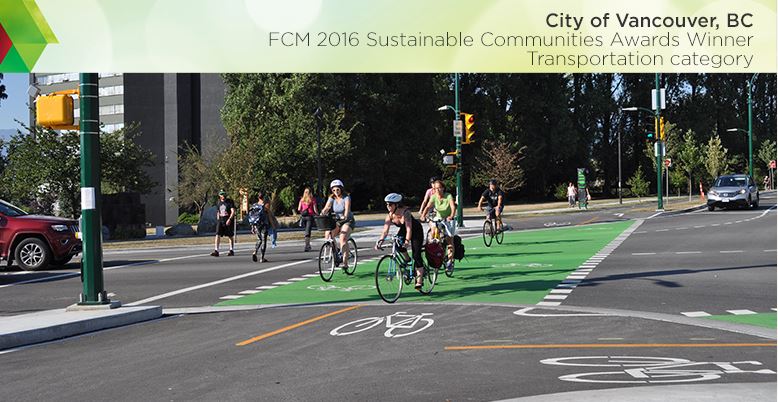
Three major upgrades to cycling and pedestrian networks in the City of Vancouver have created a seamless active transportation corridor running from the city's western neighbourhoods and across the Burrard Bridge to the downtown core. Active transportation is now safer, thanks to the Seaside Greenway, South End Burrard Bridge and York Bikeway projects, which have led to an increase of 20,000 new cycling trips per year.
Read the case study below to learn about project highlights, as well as the challenges and lessons learned that can help your community in planning similar projects.
About the project
Municipal population
Project duration
Total project value
603,502
December 2012–June 2014
$12 million
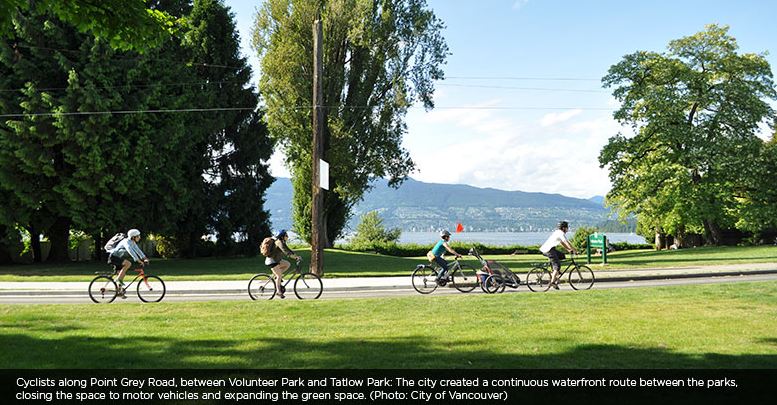
Setting a new high water mark for active transportation infrastructure and healthy communities, the City of Vancouver has dramatically improved cycling and walking connectivity throughout a major waterfront corridor running from Vancouver's western neighbourhoods to its downtown core.
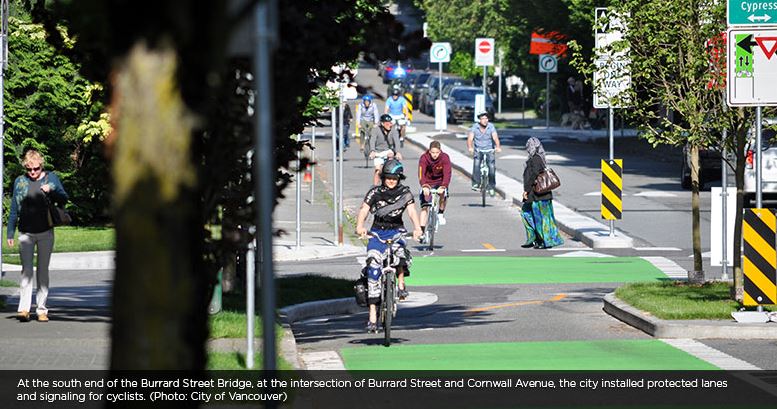
The entire 28-kilometre Seaside Greenway route is now a seamless, safe corridor for cyclists and pedestrians. The city closed a three-kilometre gap in the Seaside Greenway (the Seawall), where pedestrians and cyclists previously had to travel along busy Point Grey Road, by redirecting traffic and converting the road into a quiet greenway. The city also created the York Bikeway to extend the cycling corridor to the Burrard Bridge. The bikeway features protected bike lanes, bicycle signals and alternating one-way streets to calm traffic. The city also reconfigured the intersection at the southern end of the Burrard Bridge, making it simpler and safer for cyclists, pedestrians and motorists. With Dutch design features such as protected road space for cyclists and protected signal phases, it is now one of the most complete multi-modal intersections in North America.
The projects have enhanced waterfront access and sustainable transportation opportunities for people of all ages and abilities. They help to fulfill the city's Transportation 2040 goals, and they contribute to Partners for Climate Protection (PCP) Milestone 5 (corporate and community).
"People in the city are now realizing that walking or riding a bike is an extremely viable option to getting into their car, whether it's for work, play, shopping or whatever else they are doing around the city."
— Councillor Heather Deal
Project Highlights
Results
Environmental
Economic
Social
Contributes to municipal 2020 target to reduce vehicle kilometers travelled by 20 per cent per capita from 2007 levels
Contributed to walk/bike/transit target of 50 per cent, achieved in 2014
No increase in motorized traffic congestion
97 new trees and 2,850m² of paved surface converted to green space
Simple, cost-efficient traffic calming measures and reallocation of existing road space to accommodate bicycles
Avoided major infrastructure upgrade to Burrard Bridge by improving cycling and pedestrian capacity rather than widening the bridge or adding a separate crossing
More affordable commuting for people who choose cycling
Increase in annual cycling trips across the Burrard Bridge from 1.0 million in 2013 to 1.4 million in 2015
Improved public access to waterfront
Increased percentage of women cycling across the Burrard Bridge on weekdays (from 33 per cent in 2012 to 38 per cent in 2014)
Safer active transportation infrastructure
Challenges
It took time for the city to identify and agree on the best model for the intersection at the south end of the Burrard Bridge, because the chosen design was a new type of intersection for North America.
To calm traffic on Point Grey Road, the city installed a permanent diverter that could not be moved. When adjustments were needed to accommodate changes in traffic patterns, the city had to install an additional diverter.
City staff had to reconcile manual "before and after" counts. The city did not install automatic bicycle count equipment in time to track the beginning of heavy ridership over the summer. Additionally, the city could not use automatic equipment to track bicycle trips prior to construction, because bicycle traffic was mixed with motor vehicles.
Lessons learned
Be bold and courageous: build on the momentum and support generated during municipal planning efforts by taking on "hard-to-do" projects right away once long-range plans are established.
When altering streets and intersections to better accommodate cyclists and pedestrians, draw individual elements from best practices in other jurisdictions to create unique configurations tailored to local needs.
Apply the new model to a whole corridor or network of streets, rather than imposing the change on a single street or intersection. This increases the impact and the likelihood of successful uptake.
Conduct continual network monitoring in various forms (including traffic cameras and trip count equipment) to measure results and inform ongoing adjustments.
Want to explore all GMF-funded projects? Check out the Projects Database for a complete overview of funded projects and get inspired by municipalities of all sizes, across Canada.
Living smarter in 2020: a plan for taking action on climate change
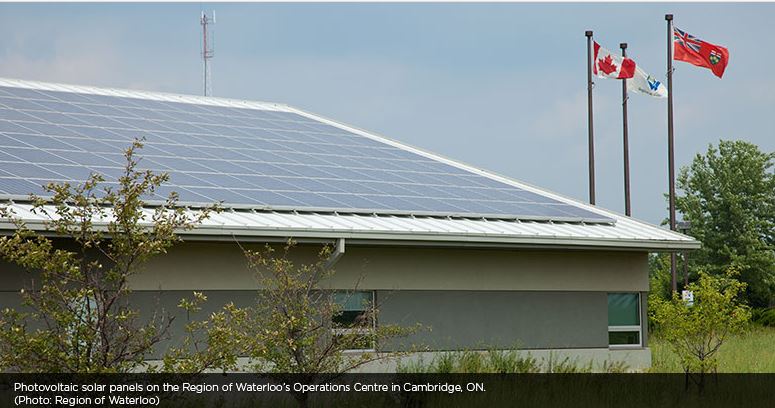
With three cities and a regional government pulling together to address climate change, the Region of Waterloo in southern Ontario has prioritized its clean technology and sustainable energy sectors.
Read the case study below to see highlights of the region's award-winning plan, and learn about the challenges and lessons learned that can help your community in a planning a similar initiative.
About the project
Municipal population
Project duration
Total project value
569,000
2010–2020
$385,000
Acting together, the Region of Waterloo and the three cities within its boundaries (Waterloo, Kitchener and Cambridge) have developed and begun implementing a local climate action plan that will reduce emissions, improve energy efficiency, and contribute to the prosperity of the entire region. Two local non-profit organizations worked closely with the four councils to develop the plan with shared targets and timelines. Local electric and gas utilities were also involved in developing the action plan and emissions reduction target. Stakeholders from 28 different organizations participated as well.
All four councils unanimously endorsed the plan and each administration committed to the same target: a 6 per cent reduction in GHG emissions from 2010 levels by 2020.
The action plan addresses energy use in homes and businesses, sustainable transportation, waste diversion and waste-to-energy generation, and touches on the role of sustainable water use and agricultural production. Implementation of a sample of 13 of its actions is expected to save businesses and residents more than $21 million, and generate nearly 5,400 person years of employment. Over time the plan is expected to stimulate growth in the clean technology and sustainable energy sectors within the region.
"It's not surprising that the climate action plan has received such acceptance here. We have a history of working together, of trying to get everyone to work toward common goals, and I think that played a strong role."
— Regional Chair Ken Seiling
Project Highlights
Results
Environmental
Economic
Social
6 per cent reduction in GHG emissions from 2010 levels by 2020
Reduce energy use in homes and businesses
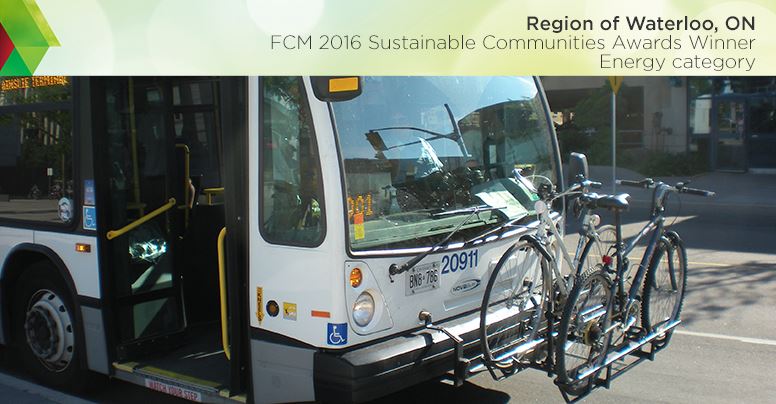
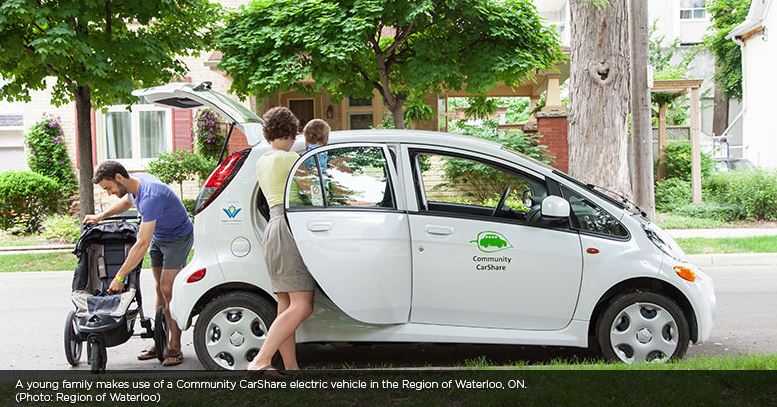
Increase transit use, cycling, walking, and car sharing and pooling
Improve solid waste diversion to minimize emissions from landfill
Add $350 million value to the local economy
Create more than 600 full-time local jobs lasting more than a decade
Save $21 million on household and business energy costs
Increase community involvement in climate actions
Improve public health and air quality
Save $10.5 million in health care costs related to air pollution
Increase street safety, interaction between people
Foster healthier homes and workplaces
Challenges
Working with a large group of stakeholders takes time and commitment. The effort is worth it to achieve consensus and have the partner groups take ownership of the plan, but don't assume it will be easy.
Identifying measurable actions: people generate a lot of great ideas but many of them require extensive advance analysis to determine whether they are realistic and if they have a business case that stimulates the necessary financial support.
Collecting data and crunching numbers is demanding, but without it you can't plan concrete steps. You need the capacity to put numbers into action.
Ongoing measurement is only part of the task: you need to collate and capture the results and translate them into terms that the public and stakeholders can easily understand. Communicating the need for change, co-benefits of actions and the path to reach the reduction target is important to gain widespread support.
Lessons learned
Link environmental and economic benefits. It is critical for engaging people. By demonstrating cost savings, job opportunities and economic spinoffs, you can reach people with different priorities.
Coordinate the work of municipalities, utilities and non-profit organizations. It sends a powerful message that this is really what the community wants, and helps build support.
Develop a realistic community engagement strategy based on financial and staff capacity. Focus on high-quality interactions with a few key people.
Use accessible off-the-shelf tools such as Twitter and Facebook for online engagement.
Hire a full-time dedicated project manager to see the project through from start to finish.
The process will take more time than you expect. Add some extra contingency time to your schedule.
Want to explore all GMF-funded projects? Check out the Projects Database for a complete overview of funded projects and get inspired by municipalities of all sizes, across Canada.
Redeveloping brownfields is one of the most promising ways to promote the environmental, economic and social health of your municipality. These success stories show how local governments across Canada have played a key role in returning a brownfield site to productive use.
Use these case studies to:
See the different approaches municipalities have taken to redevelop brownfield sites
Learn about the costs and benefits involved with different types of remediation
See how brownfield redevelopment projects benefit communities through public space, neighbourhood aesthetics, job creation and property tax
This resource is designed for municipal staff, such as brownfield coordinators, planners and economic development officers, who are responsible for overseeing brownfield redevelopment in their community.
Want to explore all GMF-funded projects? Check out the Projects Database for a complete overview of funded projects and get inspired by municipalities of all sizes, across Canada.
New wastewater treatment facility uses green technology
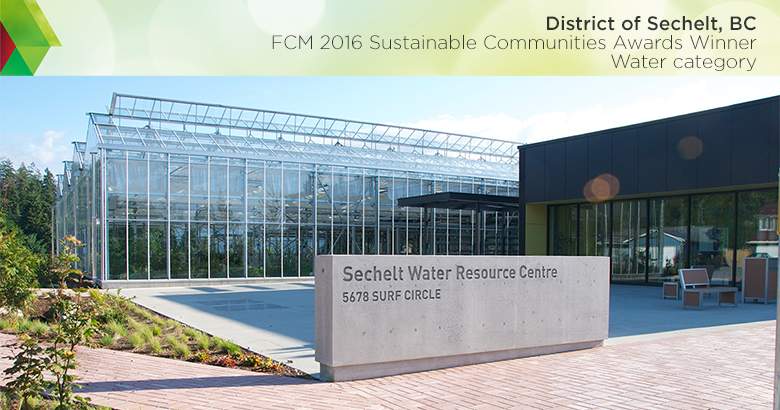
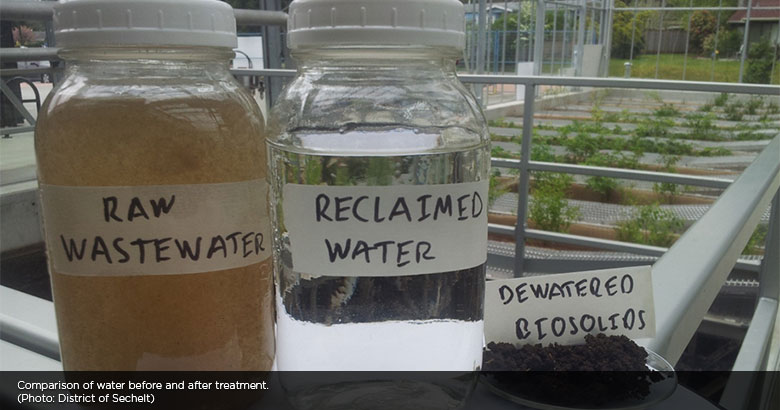
The District of Sechelt's new Water Resource Centre won an FCM Sustainable Communities Award for its community-friendly facility that uses an innovative, odour-free method to turn wastewater into high-quality reclaimed water and Class A compost.
Read the case study below to learn about the project highlights, its challenges and the lessons learned that can help your community in planning similar projects.
About the project
Municipal population
Project duration
Total project value
9,500
January 2012–December 2015
$25 million
Located in the middle of town between residential housing and the Sechelt Marsh nature reserve, the new Sechelt Water Resource Centre exceeds the treatment capacity of the two older wastewater treatment plants it replaces. The treated effluent is so clean that it eliminates the need to extend an outfall pipe into the Pacific Ocean.
The facility is designed to meet LEED® Gold certification and includes:
a 12-kilowatt solar energy roof
a heat recovery system
comprehensive odour-control technology
tertiary treatment using ultrafiltration membranes and UV rays
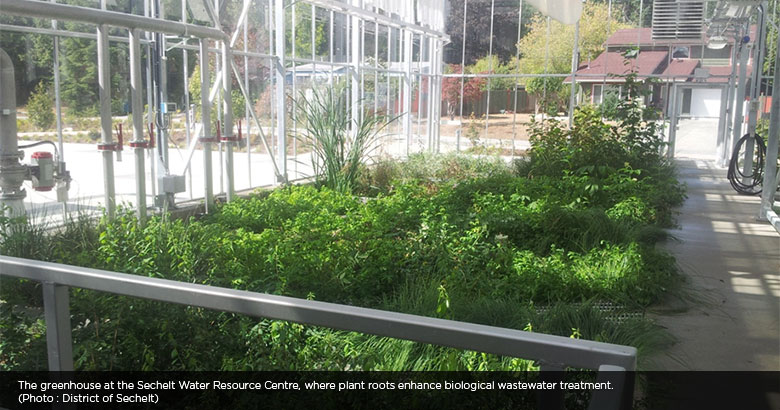
It is the first in North America to use a sequencing batch reactor process in which plants are suspended over treatment tanks enclosed in a greenhouse. The plant roots enhance the biological treatment process by making it more efficient, reducing energy and space requirements, and controlling odour. The landscaped grounds are fully accessible to the public and include habitat restoration of a small stream area. The centre, built with support from FCM's Green Municipal Fund, also hosts educational tours.
"The water resource facility gives Sechelt a clear vision for the future. It allows us to take a waste product and turn it into a resource."
— Mayor Bruce Milne, District of Sechelt
Secondary effluent is filtered through ultrafiltration membranes and disinfected with ultraviolet light. The resulting water surpasses standards for indirect potable uses such as irrigation. A local company composts the biosolids into a Class A compost product suitable for unrestricted use.
Project Highlights
Results
Environmental
Economic
Social
95 per cent reduction in suspended solids in effluent, with similar reductions in un-ionized ammonia and overall fish toxicity
Chlorine eliminated from effluent disinfection
38 per cent reduction in energy consumption
88 per cent reduction in potable water consumption within the facility
Nearly double the treatment capacity of two older plants, with minimal increase in operating costs
High-quality non-potable water resource generated
Partnership with local company to compost biosolids into Class A product
$3 million saved by eliminating the need to expand the ocean outfall
Elimination of odour and noise from older treatment plants
Improved visual appearance of facility
4700 m2 of landscape restoration, connected to adjacent nature reserve, with public access to grounds
Educational tours
Challenges
Although the district consulted with the public prior to launching the project, community members voiced concerns prior to and during construction. Ongoing public engagement throughout the process would have helped to address concerns.
Working with innovative technology meant that the district had to educate people about the technology without any North American examples to demonstrate its success.
Lessons learned
Consider a design-build approach, which greatly simplifies project delivery and ensures greater accountability within the project team.
Hire an experienced project manager and a separate owner's engineer, to oversee the logistic and technical aspects of the project, respectively.
Secure a strong commitment from elected officials and municipal staff to stay open to innovation and creative solutions, even if this means entering "uncharted territory."
Make community engagement a priority and share all information as soon as it is available. Work with the community to establish the vision and objectives, while consulting specialists on the technical aspects.
Want to explore all GMF-funded projects? Check out the Projects Database for a complete overview of funded projects and get inspired by municipalities of all sizes, across Canada.
Brownfields Redevelopment Grant Program revitalizes Edmonton neighbourhoods
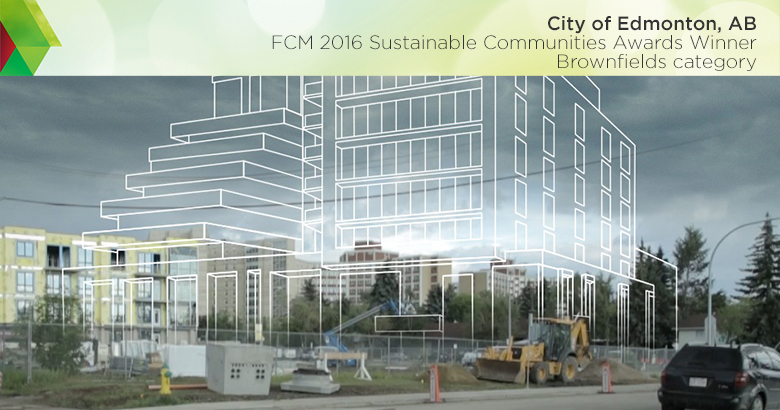
The City of Edmonton's Brownfield Redevelopment Grant Program won an FCM Sustainable Communities Award for its strategies to clean up former refuelling sites and revitalize their community.
Read the case study below to learn more about program highlights, as well as the challenges and the lessons learned that can help your community in planning a similar initiative.
About the program
Municipal population
Project duration
Total project value
800,000
April 2010–present
$5.8 million in funding committed to date (October 2015);
$70,000 in start-up costs
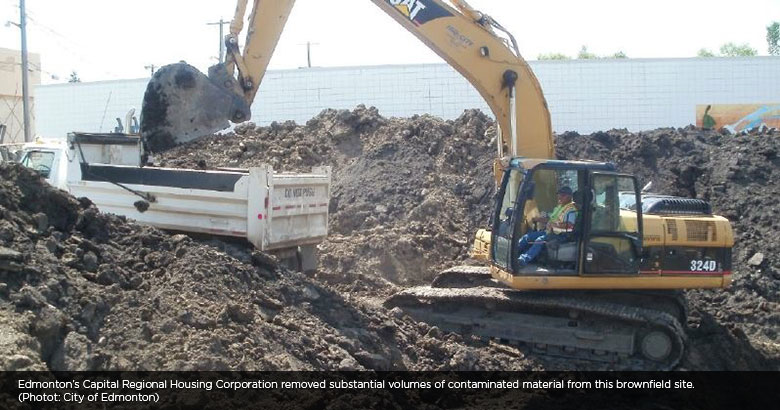
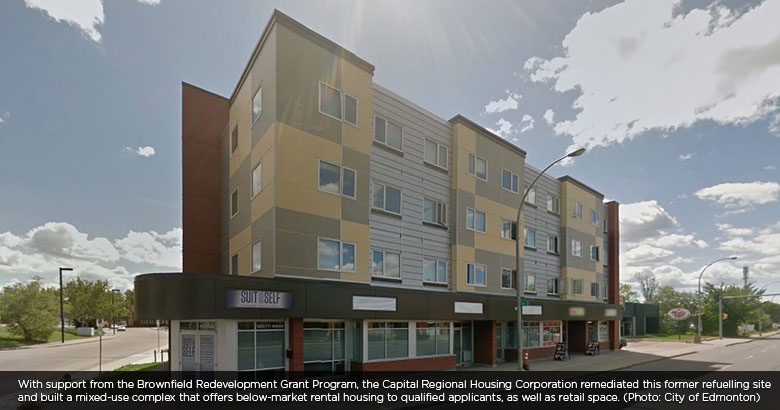
The City of Edmonton's Brownfield Redevelopment Grant program offers grants for all stages of brownfield remediation and includes environmental performance incentives. Initially developed with support from FCM's Green Municipal Fund, the program first targeted 50 contaminated gas stations and was later expanded to include all refuelling sites within the City of Edmonton. A task force of city councillors worked closely with a multidisciplinary staff team to create the program, which drew on extensive research into best practices in Canada and beyond, as well as consultation with local property owners, developers and industry experts. A municipal brownfield coordinator acts as a single point of contact for any brownfield-related inquiry.
The program provides financial support through four main phases of brownfield redevelopment:
Phase 1: Historical Investigation — Phase I Environmental Site Assessment
Phase 2: Testing, Delineation, Remedial/Exposure Control Planning — Phase II Environmental Site Assessment
Phase 3: Site remediation
Phase 4: Remediation/Exposure Control with an innovative interim land use solution
Phase 3 offers a grant for up to 100 per cent of remediation costs to qualifying applicants whose redevelopment plans meet Leadership in Energy and Environmental Design (LEED®) Silver standards. Grants for this phase are calculated based on anticipated increases in property tax revenue.
The task force was very specifically set up to look just at contaminated gas station sites, and it's turned out to be a really good test case for how you can deal with brownfields in a more generic sense.
— Councillor Ben Henderson
Project highlights
Results
Environmental
Economic
Social
Eight major remediation projects completed or underway, with more to come
Increased urban density, reducing urban sprawl
Many buildings certified LEED® Silver or higher, with some incorporating cogeneration and solar energy
Over $2 million per year in new property tax revenue anticipated
Derelict sites transformed into new buildings
Existing infrastructure serves increased urban density (lower construction and maintenance costs/capita)
Revitalization benefits neighbouring businesses
Beautification of existing neighbourhoods and fewer public-nuisance areas
Mixed-use developments, for a more liveable, walkable downtown core
New housing in areas already accessible to public transit and other amenities
Challenges
Applicants often need assistance with calculating the value of potential grants vis-à-vis the anticipated remediation costs and projected increase in property value.
Once sites with lower remediation costs were redeveloped, feedback indicated that the funding available for Phase 3 (remediation) no longer provided enough financial incentive. The city increased the amount of funding available for this part of the program, and added an innovative performance-based incentive.
Challenges arise for projects that do not meet the requirements for 100 per cent funding under Phase 3 (remediation). If remediation costs are high, it may be difficult for the owner to recover the remaining costs, particularly in cases where zoning restricts the scope of redevelopment.
Lessons learned
Plan to adjust and update the program once easier, more affordable projects have been completed and the "low-hanging fruit" disappears.
Tie a performance standard (such as LEED® Silver or Gold) to grant eligibility.
Research best practices from other jurisdictions (regardless of size) to understand what works.
Promote the program through environmental consultants, construction firms and other professionals who benefit from brownfield redevelopment projects and are motivated to identify prospective applicants.
Ensure that city councillors are familiar with the complexities of brownfield redevelopment, to help build their support for effective solutions.
Establish a municipal brownfield coordinator as the single point of contact for owners and developers.
Establish a multidisciplinary team of municipal staff to handle all matters related to contaminated properties.
Want to explore all GMF-funded projects? Check out the Projects Database for a complete overview of funded projects and get inspired by municipalities of all sizes, across Canada.
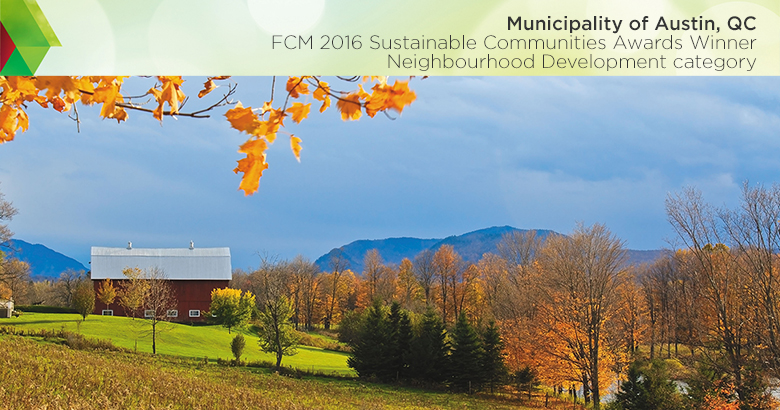
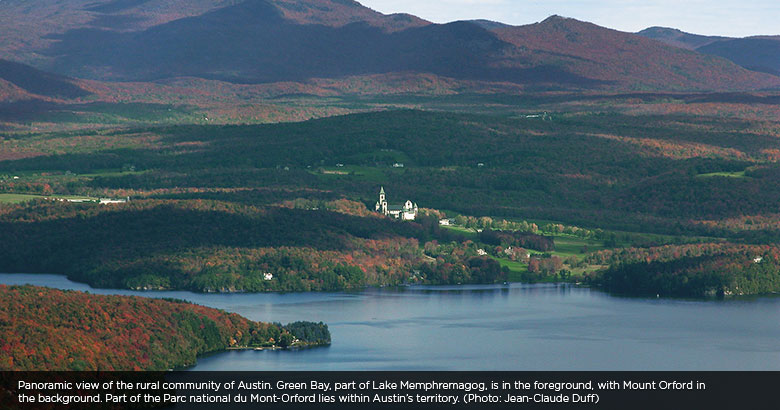
Known for its beautiful scenery, rich biodiversity and major ecosystems, Austin adopted a sustainability action plan for what is considered one of the prime resort areas in Quebec. This innovative plan is based on excellent knowledge of the forest, lakes and wetlands. It serves as a comprehensive management reference for sustainability in governance, the environment, the economy and society.
Read the case study below to learn about project highlights, as well as the challenges and lessons learned that can help your community in planning similar projects.
About the project
Municipal population
Project duration
Total project value
3,515 (1,507 permanent and 2,008 seasonal)
February 2013–December 2014
$107,200
Before beginning to work on its action plan, Austin wanted to determine the areas in which residential and commercial development could be appropriately implemented. This involved evaluating and mapping the load capacity of the municipality's land and water ecosystems.
Strategic planning was supported by a collaborative approach that for nearly two years engaged elected officials, citizens, local organizations and stakeholders. This approach gave rise to a strong common vision upon which the municipality built a structured action plan focused on four main areas:
protecting and enhancing heritage
making the community and living environment dynamic and lively
aligning development with the community's vision and values
meeting new municipal management realities
This plan is divided into 20 sections, with details on 87 actions to achieve the municipality's vision.
"The Green Municipal Fund, which funded much of the project, led us to the resources and coordinating all the work but also consultation with specialists in the field. It was fundamental."
— Mayor Lisette Maillé
Project highlights
Results
Environmental
Economic
Social
Protection of surface and groundwater, and local conservation areas
Reduced municipal greenhouse gas emissions and energy consumption
Promotion of sustainable transportation and improved waste management
Preservation of landscapes and the municipality's rural heritage — much of Austin's income comes from seasonal tourism
Economic development based on residential services, aligning with commercial development
Support for sustainable agriculture, partly through incorporating the recently adopted Memphremagog RCM agricultural development plan, which includes the land bank project
Open, collaborative approach fostered cohesion in the community, to be more inclusive of people of all ages and to bolster cultural development and social/cultural activities
Dynamic, engaging environment that creates a stronger community and protects its environment, culture and heritage
More transparent governance
Challenges
This project required collaboration among and outside the traditional silos, so the various stakeholders' roles had to be clarified: elected officials, employees, committees, local groups, citizens.
Development of the action plan and the related urban plan review hit a recurring snag: the municipality's environmental stewardship role and the opposition between community property and private property. Austin had to insist on the concept of community property and sustainability (future generations, legacy, etc.) to overcome the perceived detriment to property rights.
The plan had to be flexible enough to incorporate new actions as the project advanced, and had to become a practical management aid.
Lessons learned
Action plan development was supported by a number of innovative aspects that any municipality facing similar issues could use: consideration of the load capacity of land and water ecosystems; inclusion of stakeholders in the process; adaptation of the sustainable neighbourhoods concept for a rural community; participative strategic planning that incorporated municipal obligations and commitments.
To complete such a project, it is important to set up a team of specialists in various disciplines (geographer, biologist, urban planner, etc.) who work together with open minds.
Such a vast project requires many resources and involves substantial costs. The funding from FCM's Green Municipal Fund was very helpful.
The project's success depends largely on the elected officials' political support and commitment, and that of the municipal staff; it also requires them to accept change.
The project team, consisting of three environment professionals, was a determining factor in the project's success.
Marie-Élaine Lacroix
Spécialiste et inspectrice en environnement Municipality of Austin
T. 819-843-2388 x 229
Want to explore all GMF-funded projects? Check out the Projects Database for a complete overview of funded projects and get inspired by municipalities of all sizes, across Canada.
Effectively communicating your municipality's redevelopment opportunities and incentive programs to property owners and developers is key to their success. This guide outlines steps to help you find and engage the right developers and collaborators for brownfields sites in Canadian cities and towns of all sizes.
Read this guide and learn how to:
Define your objectives and conduct market research to develop an effective marketing plan
Identify the right brownfield contact person for your municipality
Create compelling communication materials designed to drive action in developing your brownfield sites
Effectively engage and work with your target audience
The guide also includes case studies that offer creative ideas and practical examples that you can apply in your municipality.
The guide is designed for: Municipal staff, such as sustainability coordinators, planners, project managers, economic development officers and chief administrative officers, who are responsible for creating and implementing a brownfield strategy.
Are you looking to meet the new federal Wastewater Systems Effluent Regulations in your municipality?
Join our webinar to learn proven practices to help you identify ways to optimize your existing wastewater treatment resources. Speakers from the Ontario Ministry of the Environment and Climate Change and the Grand River Conservation Authority will share lessons learned that you can apply in your municipality.
During the webinar, you'll:
Review best practices for data collection and management to make the best use of your current infrastructure, funding and people.
Identify how your municipality can use data to better manage your municipal assets, improve your processes and produce better effluent.
The webinar is intended for municipal staff and elected officials. It is presented in English only.
It features two presentations:
Part 1: Development of training and programs to promote wastewater treatment optimization in Ontario
This presentation will identify lessons learned from a pilot program designed to promote optimization of wastewater treatment plants.
Speaker:
Aaron Law, Senior Program Analyst, Ontario Ministry of the Environment and Climate Change
Part 2: Optimizing wastewater treatment in the Grand River Watershed: Everybody wins!
This presentation will feature case studies that show how collecting the right data helps municipalities manage their assets better, ensure more stable process control and improve effluent quality.
Speaker:
Mark Anderson, Water Quality Engineer, Grand River Conservation Authority
Brownfield redevelopment project revives a central neighbourhood
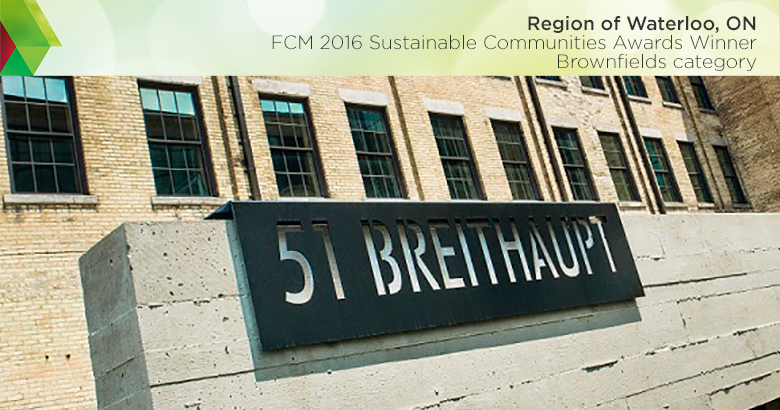
Working with a visionary developer, the Region of Waterloo and the City of Kitchener helped transform an industrial brownfield site in Kitchener's downtown into showcase offices, attracting tenants such as Google and reviving a central neighbourhood.
Read the case study below to learn about project highlights, as well as the challenges and lessons learned that can help your community in planning similar projects.
About the project
Municipal population
Project duration
Total project value
569,000
2009–2015
Regional Municipality of Waterloo and City of Kitchener contribution: $1,559,993
Perimeter Development Corporation investment: $54M
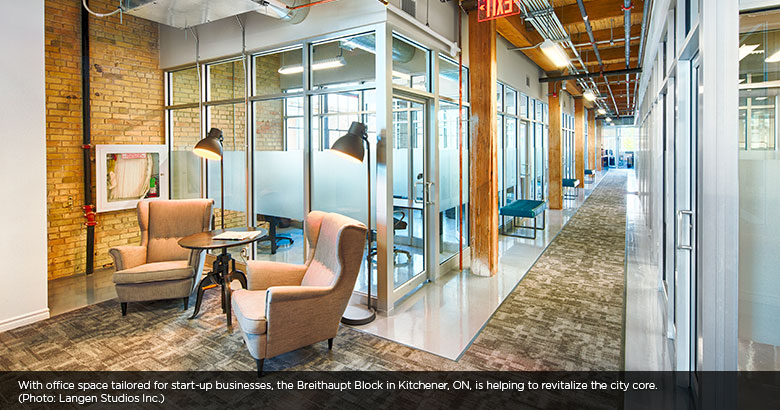
The Region of Waterloo and the City of Kitchener, ON, worked closely with the Perimeter Development Corporation to turn an abandoned industrial block near its downtown into a technology-oriented office space. The project is bringing new jobs and life to a central neighbourhood.
The Breithaupt Block is located in Kitchener's city core close to a planned transit hub. The site, vacant since 2007, had century-old buildings with great renovation potential. However, both soil and groundwater on the site were contaminated with industrial pollutants including hydrocarbons, zinc and benzene. Perimeter bought the block in 2009, planning to transform it into high-quality office space. The city and region supported the development with grants to help cover environmental assessment and site remediation costs.
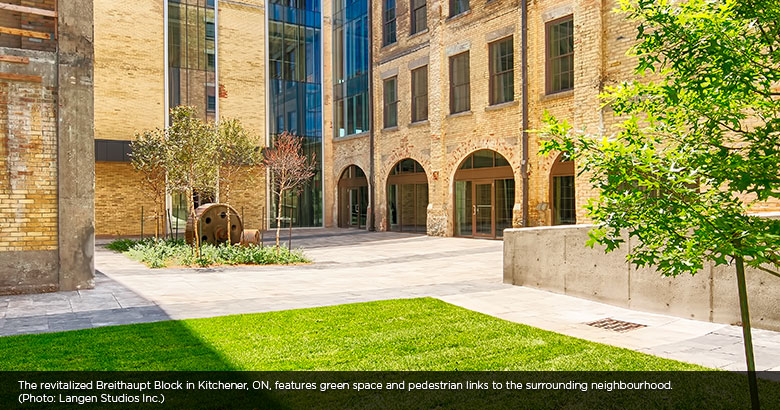
The development includes beautifully renovated historic brick and beam buildings and an energy- and water-efficient LEED® Gold addition. The project, which has attracted tech-focused tenants including Google, is generating job opportunities downtown and sparking new growth in the surrounding neighbourhood.
"This is the kind of thing that can happen when you redevelop brownfield sites, when you bring transportation and transit together, and create a livable, economically viable centre core part of the city."
— Regional Chair Ken Seiling
Results
Environmental
Economic
Social
Remediated contaminated site, reducing possible health risks
Increased energy, water efficiency with LEED Gold component
Reduced GHG emissions by promoting active transportation, discouraging use of cars
Reduces sprawl, increases density, makes better use of existing infrastructure
Expanded business tax base
Developed office space tailored to start-up businesses
Increased employment opportunities in downtown
Produced economic spin-off in local service industry
Preserved character and architectural heritage of the site
Introduced green space, pedestrian links between neighbourhood and transit hub
Created attractive community destination in residential neighbourhood
Contributed to community health and wellbeing
Challenges
The Breithaupt Block needed a developer with vision. It was a challenging industrial site with vacant buildings and ponds of process water, but its location in a central neighbourhood and adjacent to a planned transit hub meant it could be pivotal for the city's redevelopment.
The first hurdle for the project was getting rid of heavy industrial machinery left on site by the previous owner. The developer found a recycling company that cleared the site in exchange for the value of the recycled material.
Coordinating the Breithaupt development with the region's light rail transit plans has been demanding, involving regular contact with representatives from Kitchener's planning department, two Region of Waterloo departments and the consortium building the transit system.
Lessons learned
Designate a single contact person from the municipality and ensure that there is regular communication between the developer and municipal staff.
Try to develop realistic expectations and timelines; brownfield redevelopment almost always takes more time and more money than you expect.
Be patient. Remediation takes time. Redevelopment takes time and reimbursing eligible expenses takes time.
Share your vision with the developer and try to ensure that all parties have the same understanding. Sharing a vision and philosophy for brownfield redevelopment goes a long way toward building trust and collaboration on a project.
Offer tax incentives for brownfield projects. Developers are more likely to tackle site remediation if they can recover a portion of the costs. It may also help them to negotiate project financing.
Want to explore all GMF-funded projects? Check out the Projects Database for a complete overview of funded projects and get inspired by municipalities of all sizes, across Canada.



 Sustainable neighbourhoods — dense, walkable, mixed-use communities — foster healthy lifestyles and strong social connections, save on municipal operating costs and achieve environmental goals. To encourage sustainable neighbourhood development, municipalities across Canada must overcome common challenges including strict regulations, financial barriers and more.