This article is part of a series calledSix sustainability ideas that have gone mainstream in Canada. Each article explores an innovative sustainability idea that may have seemed radical a decade ago but is now considered a best practice. The series features inspiring ideas and projects being implemented in Canadian cities and towns of all sizes, plus resources to help you implement these solutions in your community.
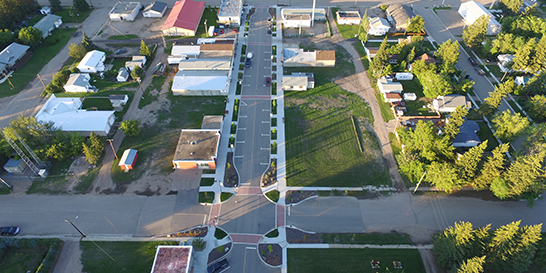
Marwayne, AB revitalized its Center Street and reduced village's carbon footprint while creating an appealing space for residents doing day-to-day business and attending public events.
Canadian municipalities are facing some critical challenges that have an enormous impact on energy consumption and resilience:
our population and infrastructure are aging
our climate is changing, resulting in more weather-related crises
our housing is less affordable and adaptable than is desirable
Low-carbon design and better land-use planning that incorporate sustainability principles can help alleviate these pressures.
What is low-carbon design?
Sustainable and low-carbon neighbourhoods are relatively compact, mixed-use communities with good access to transit that incorporate a range of housing, workplaces, parks, amenities, shops and services. In addition to sustainability, they contribute economic and social benefits to the community.
The principles of low-carbon design have been around for years but widespread acceptance has been slow. What's needed is a new development model that is both financially viable and focused on creating lasting social, economic and environmental value.
The key is to promote a shift in thinking that brings local governments, developers and community members to the same table to work toward their mutual benefit.
Design low-carbon neighbourhoods to reduce greenhouse gas emissions by more than 50 per cent
The benefits of this approach to land-use planning are significant.Dense, mixed-use communities can reduce:
energy use and greenhouse gas emissions by more than 50 per cent
infrastructure lifecycle costs by more than 25 per cent
the risks from flooding and other related climate change impacts
This series was inspired by "From Crazy to Common Sense: 'Radical' Ideas Whose Time Have Come," a workshop that was held at the Federation of Canadian Municipalities' 2016 Sustainable Communities Conference.
Move ideas to reality: Get funding and free resources from FCM's Green Municipal Fund
Subscribe to email updates and get the resources, training, networking opportunities and funding you need from FCM's Green Municipal Fund to implement these sustainability ideas in your community.
Want to explore all GMF-funded projects? Check out the Projects Database for a complete overview of funded projects and get inspired by municipalities of all sizes, across Canada.
FCM's Green Municipal Fund has developed this roadmap to provide a detailed overview of the process for bringing contaminated or abandoned sites back into productive use in your province.
Use this roadmap to:
Know the steps involved in a brownfield redevelopment project so you can be better prepared to avoid potential delays or cost overruns
Learn where to look for funding, including grants and incentive programs
Structure your discussions and consultations with project stakeholders
Improve your understanding of the brownfields regulatory framework in Quebec
This roadmap is designed as an easy-to-follow path to help municipalities and their partners navigate the processes, regulations and funding for brownfield redevelopment projects in Quebec.
Note: The information presented in the roadmaps is current to the publication date and may not capture all relevant programs. Please contact the responsible organizations to verify up-to-date information.
Each roadmap summarizes current provincial or territorial legislation and must not be regarded as a formal legal interpretation. Please refer to the identified legislation for complete details on requirements and seek legal advice if necessary.
Case study: Vancouver becoming world's greenest city
Already known for environmental sustainability, the City of Vancouver has adopted a plan to become the world's greenest city by 2020.
The plan sets ambitious goals to reduce air pollution and waste, foster energy-efficient construction and improve the city's natural environment. It is the product of two years of consultations with 35,000 people, including 9,500 city employees, members of advisory committees, and participants in a variety of workshops and other events.
The plan will reduce greenhouse gas emissions to two-thirds of 2007 levels, reduce water consumption to two-thirds of 2006 levels, and halve the 2008 levels of waste sent to landfills or incinerators. It could double the number of jobs in clean technology, green construction, recycling, composting and other environmentally sustainable areas. It would help to put the city in even closer touch with its natural surroundings.
Results
Environmental
Economic
Social
66 percent reduction (to 916,000 tonnes) in GHG emissions from 2007 levels by 2020
50 percent reduction (to 250,000 tonnes) in waste sent to landfills or incinerators by 2020
Double to 29,800the number of jobs devoted to environmental sustainability by 2020
Double the number of companies working to make their operations more sustainable by 2020
Cleaner air and water, more access to natural environment promotes health
150,000 new trees, more farmers' markets and community gardens will make Vancouver more liveable
Challenges
Overcoming 'silo' thinking among city staff.
Coordinating contributions from 9,500 active participants in the process.
Going beyond open houses and using online tools and social media to make community engagement "fun and easy."
Lessons learned
Set targets that are measurable, challenging and achievable.
Early adoption of the plan's goals and targets is a sign to staff that council is serious about setting a plan of action.
Use city staff, not consultants, to create the plan they must ultimately implement. This assures staff buy-in and keeps the process moving.
Amanda Mitchell
Greenest City Engagement Coordinator
Vancouver, BC
T. 604-673-8166
Want to explore all GMF-funded projects? Check out the Projects Database for a complete overview of funded projects and get inspired by municipalities of all sizes, across Canada.
FCM's Green Municipal Fund has developed this roadmap to provide a detailed overview of the process for bringing contaminated or abandoned sites back into productive use in your territory.
Use this roadmap to:
Know the steps involved in a brownfield redevelopment project so you can be better prepared to avoid potential delays or cost overruns
Learn where to look for funding, including grants and incentive programs
Structure your discussions and consultations with project stakeholders
Improve your understanding of the brownfields regulatory framework in the Northwest Territories
This roadmap is designed as an easy-to-follow path to help municipalities and their partners navigate the processes, regulations and funding for brownfield redevelopment projects in the Northwest Territories.
Note: The information presented in the roadmaps is current to the publication date and may not capture all relevant programs. Please contact the responsible organizations to verify up-to-date information.
Each roadmap summarizes current provincial or territorial legislation and must not be regarded as a formal legal interpretation. Please refer to the identified legislation for complete details on requirements and seek legal advice if necessary.
Case study: Bromont 2030 A shared vision for sustainability
Development and implementation of a sustainable area development plan
The City of Bromont, a tourist haven, is experiencing a population boom. The municipal council is taking steps to ensure that this growth occurs while respecting the environment, the surrounding countryside and the quality of life in the community.
To reach its goal, the city has adopted a sustainable development plan that sets out a vision for Bromont in 2030. Over the course of 20 public forums, residents actively participated in developing this vision - one that follows The Natural Step's sustainability framework. The five-step plan includes practical initiatives for businesses and residents and serves as a reference guide to spur the community into action.
The municipality will use the plan to identify priorities related to investment and operating costs when drafting its annual budget.
Results
Environmental
Economic
Social
Protection of water bodies and 20% of land
Direct action to conserve drinking water
40% reduction in GHG emissions by 2030 (compared to 2010 figures)
Diversification of the economy
Promotion of ethical tourism
"Shop local" campaign
Natural and historic features recognized as valuable assests
Job creation in sports and leisure sectors
Challenges
Each municipal department should make sustainable development a priority and provide appropriate training for staff.
The sustainable development plan will only succeed if all the stakeholders (municipality, business and industry, and residents) are fully invested in it.
Lessons learned
An project analysis to date shows this is a costly undertaking and progress has been limited. It would be more worthwhile to focus on a long-term goal rather than focussing on what needs to be improved.
Involving the public is especially important for defining issues and establishing a long-term vision.
Bring in an expert panel to create a concrete action and avoid the risk of being too general, or not suitably innovative.
Jean-François L. Vachon
Director of urban planning, planning and sustainable development
Bromont, QC
T. 450-534-2021
Want to explore all GMF-funded projects? Check out the Projects Database for a complete overview of funded projects and get inspired by municipalities of all sizes, across Canada.
The United Counties of Leeds and Grenville developed a Regional Integrated Community Sustainability Plan (ICSP) that provides a strategic framework for its 12 municipalities (10 members and two partners) to address sustainability objectives and priorities. The ICSP functions as a two-tier plan, operating at both the regional and local levels, with customization options that allow the municipalities to address individual priorities with local action plans. One of the largest multi-municipality ICSPs undertaken in Canada, it complements existing local community plans. The plan includes a monitoring program; and the municipalities established a governance structure to facilitate continuous improvement and annual reporting. Development of the ICSP included two rounds of public consultation, as well as online surveys and a social media presence, with support from a community liaison team. A process report, published after the plan's completion, provides a detailed overview of the methodology used to prepare the plan and serves as a useful reference for other communities.
Results
Environmental
Economic
Social
Focus on preservation of major waterways, water quality and natural environment
Targets to reduce carbon footprint and GHG emissions in municipal operations
Plans to implement energy conservation and demand-management solutions
Plans to foster economic development and diversification, with special focus on small business and local food production
Action plans to extend life span of regional infrastructure
Trails and waterways network to be expanded
Active, healthy lifestyle and trail-related tourism to be encouraged
Community needs for transit and affordable housing to be explored and addressed
Challenges
During action planning, many participants said that the ICSP should all-inclusive; however, many of the initial action plans were not achievable because of resource limitations.
Although the counties launched a Facebook account for the project, it did not generate as much interest as it might have if the counties had established a pre-existing social media platform.
In the first public consultation session, participants from the different communities were preoccupied with local issues and opportunities, and had difficulty focusing on the overall vision and principles for the region.
Lessons learned
Develop local action plans that balance the desire to include everything with awareness of resource constraints, to better support implementation and maintain momentum.
Employ a consultant to ensure that all voices are heard and to provide objective feedback; but budget sufficient staff time for liaison with rural communities, to ensure participation and support.
Establish a social media presence in advance of the planning process, to foster youth engagement and ensure their participation.
Develop a focused monitoring program that does not require too much administrative effort.
Want to explore all GMF-funded projects? Check out the Projects Database for a complete overview of funded projects and get inspired by municipalities of all sizes, across Canada.
The Campbell River Community Plan charts a course to preserve the environment, develop the economy and manage growth. It calls for sustainable policies on housing, infrastructure, transportation, energy and emissions management, and community services. By integrating the three pillars of sustainability — society and culture, the economy and the environment — the 50-year plan will allow the community to address global warming, changes in the resource sector and challenges posed by an aging population. The city partnered with three First Nations in a planning process that involved more than 1,500 members of the community.
Results
Environmental
Economic
Social
Goals and targets guide land use, ecosystems, water, a skilled work force, social equality and other priorities
A sustainability checklist guides rezoning and development permits
Green procurement strategy helps reach sustainability goals.
Redevelopment of brownfield sites for a range of residential and commercial uses.
Seventy per cent of residents living within a 20-minute walk of stores and other amenities by 2020.
Council-to-council meetings held between the City of Campbell River and the Wei Wai Kum, We Wai Kai and Homalco First Nations.
Citizens engaged through a wide variety of events and activities, including community workshops and open houses.
Challenges
Partnerships with local First Nations — essential to the success of the sustainability plan — were complicated due to long-standing grievances.
The three First Nations communities had not been included in previous official plans.
The city had to draft a suite of supporting plans for transportation, agriculture, energy and emissions, and solid waste.
Lessons learned
The council-to-council meetings with local First Nations were an important starting point.
With so many consultants involved, it was important to have a single, accountable project manager. Keeping public consultations focused on the practical steps for the community was essential.
Ross Blackwell
Land Use Manager
City of Campbell River
T. 250-286-5748
Want to explore all GMF-funded projects? Check out the Projects Database for a complete overview of funded projects and get inspired by municipalities of all sizes, across Canada.
Almost every Canadian municipality is home to a brownfield site. A brownfield is an abandoned, vacant, derelict or underutilized commercial, industrial or institutional property where past actions have resulted in actual or perceived contamination or threat to public health and safety and where there is active potential for redevelopment.
Because brownfield sites are often contaminated, they tend to be undervalued and underused. Once contamination is dealt with, municipalities gain valuable land that can be used for a wide variety of activities. The cleanup of a contaminated brownfield site is called "remediation."
Find out how your community can bring these valuable properties back into productive use and increase revenues, manage environmental risk, improve public health and revitalize neighbourhoods.
Sustainable Site Assessments: You can use various techniques to find out whether a suspected brownfield site contains contaminated soil or groundwater.
Sustainable Remediation and Risk Management Options: Any technique that remediates or manages the risk of contamination at a site has an environmental benefit as it eliminates or reduces exposure to contaminants.
The City of Parksville has developed a new Official Community Plan to address issues such as smart growth, climate change, downtown revitalization, sustainable tourism and shoreline protection.
The plan is built around sustainability goals that will guide future land use and development policies. These goals include support for mixed-use development and compact housing, alternatives to automobile transportation, increasing water and energy conservation and lowering GHG emissions.
The city plan will support the development of a "live-work" culture, protect the community's natural heritage and encourage residents to buy locally and to explore the local environment.
With the new Official Plan in place, Parksville is poised for its future as an attractive, economically vibrant community with sustainable amenities and services for permanent residents and tourists alike.
Results
Environmental
Economic
Social
Reduce per capita GHG emissions to 33% of 2007 levels by 2020
Reduce municipal CO2 emissions by at least two tonnes annually
Factor climate change adaptation into all new development
Support a diverse local economy
Build productive relationships with local economic sectors
Encourage local purchasing
Support mixed land-use to promote a "live-work" environment
Provide opportunities to live, work and play in the city, to reduce travel and improve health
Offer alternatives to automobile transportation
Develop a more walkable community
Challenges
Many members of the public found the legal requirements for an Official Community Plan difficult to understand and were frustrated that some of their suggestions could not be incorporated.
It is difficult to involve busy young adults in the community. The youngest residents attending public hearings were in their mid fifties.
Lessons learned
Manage public expectations. The content of an OCP is strictly governed by the Local Government Act. Explain to stakeholders how this limits the plan to land use or community development.
Hire an independent facilitator or consultant to manage the committees, encourage open discussion and avoid getting caught up in political issues.
Build flexibility into the planning process. There will almost certainly be delays and requirements for additional resources.
Want to explore all GMF-funded projects? Check out the Projects Database for a complete overview of funded projects and get inspired by municipalities of all sizes, across Canada.
The City of Mississauga has a master plan to instill environmental consciousness in its corporate DNA. The plan outlines actions the city can take to meet the environmental goals in its 2009 strategic plan.
That means developing a transit-oriented city, making neighbourhoods more livable and connected, and helping residents and businesses make environmentally sustainable decisions. The plan has three categories of actions for the city to implement over the next decade: ways to set an example, ways to encourage others, and ways (like regulations and bylaws) to compel others. The plan includes indicators to measure the city's environmental progress
Results
Environmental
Economic
Social
Conserves energy and water and reduces waste by greening city facilities
Reduces dependence on fossil fuels by using clean, renewable energy (solar, wind, biofuels)
Reduces reliance on cars by expanding public transit
Preserves or restores natural environments
Attracts businesses and ensures prosperity by security and cost stability of renewable energy sources
Creates walkable, connected neighbourhoods with reliable public transit and cycling routes
Promotes population health through clean air and active lifestyles
Challenges
Too short a time frame for the project.
Building confidence among city staff that the master plan would support their programs, rather than dictate priorities.
Changing habits among city staff and in the wider community.
Finding the money to properly implement the plan.
Lessons learned
Create a realistic schedule.
Allocate sufficient resources, including a special events planner, for the public consultations. These events raise awareness of and build support for the plan.
Budget for an editor and designer to make a reader-friendly final plan.
Mary Bracken
Project Lead, Living Green Master Plan
City of Mississauga, ON
T. 905-615-3200, ext. 4918
Want to explore all GMF-funded projects? Check out the Projects Database for a complete overview of funded projects and get inspired by municipalities of all sizes, across Canada.