


Case study: Canada’s first electric community waste-collection truck hits the road
How British Columbia’s University Endowment Lands reduced emissions and operating costs by electrifying waste collection
 MUNICIPAL FLEET ELECTRIFICATION
Zero-emission vehicles
British Columbia
Summary
University Endowment Lands (UEL) has made history by being the first Canadian community to put an electric waste-collection truck on the road.
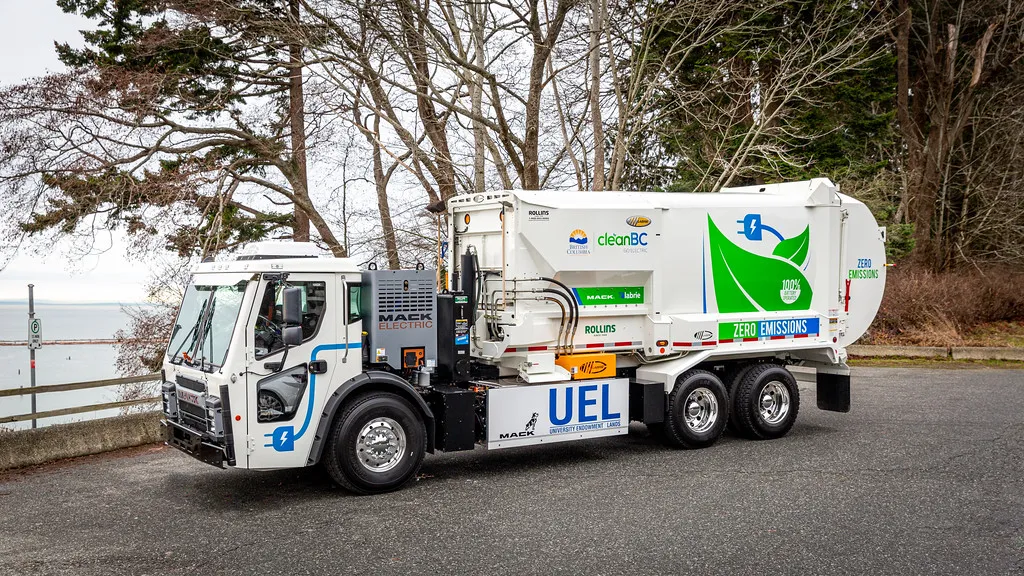
After doing some homework and getting community buy-in, UEL added a Mack Electric Automated Side Loader with a 264-kWh battery to its fleet. The truck’s charging infrastructure, designed to reduce peak demand usage, is further offset by a solar PV array.
The community loves to see the quiet truck making its way along its routes, leaving no loud noise or diesel fumes in its wake. Saving UEL $6,000 a year in fuel costs alone, the truck is well on its way to paying for itself in the estimated timeframe of twelve years.
Residents love to see the truck around. It’s so quiet as it goes down the road, and adopting electric technology and greenhouse gas emissions reductions are really important to our community. —Will Emo, Manager, University Endowment Lands
Quick stats
- The first electric community garbage truck to be used in Canada
- Cost offset by a $100,000 rebate from a federal government incentive (iMHZEV: Incentives for Medium- and Heavy-Duty Zero-Emission Vehicles)
- About 5,000 litres/year of diesel fuel avoided, saving $6,000/year
- Up to 19.5 tonnes of greenhouse gas emissions eliminated annually
- Significantly lower maintenance costs
- Vehicle charging network includes a 27-kW PV array to offset hydro demand
Background
University Endowment Lands (UEL) is an unincorporated community of nearly 5,000 people in Metro Vancouver, British Columbia.
UEL carries out its own waste collection, with two trucks in service. As the trucks approached the end of their lifecycles, UEL decided to explore purchasing an electric model to collect waste.
With UEL’s direction and sustainability strategy aligned with CleanBC goals of reducing emissions by 40 percent by 2030, fleet electrification was already a long-term project for the community. UEL started by electrifying light-duty and specialized equipment before turning to medium- and heavy-duty vehicles. It has already electrified much of its fleet, notably a pick-up truck, a Class 3 dump truck, and outdoor maintenance equipment like lawn mowers and leaf blowers.
The Challenge
Already strongly committed to lowering emissions through fleet electrification, UEL needed to find a way to add an electric garbage truck to its fleet—still a pretty new technology—without sacrificing reliability. If charging the truck went wrong, or if the truck broke down or needed to go in for maintenance, there would be no waste collection.
The other challenge was financial. Although electric garbage trucks save money in the long term, they cost about twice as much up-front as conventional ones. Doing the studies, figuring out the budget and financing, and getting internal buy-in were all key.
Approach
Although UEL was ready to replace one of its diesel refuse-collection trucks with an electric model as early as 2018, it decided to wait for an optimal vehicle to come onto the market.
Taking things slowly allowed UEL to line everything up for successful integration of the electric waste-collection truck. The approach UEL took was two-fold: making sure institutional buy-in and financing were in place; and making sure the right infrastructure was in place for the truck’s arrival.
Financial/institutional readiness
UEL built a business case clearly showing the benefits of an electric waste-collection truck to get buy-in from finance, operators and other staff. With the entire community on board, UEL explored financing options and rebates and saw it would be able to benefit from a federal government rebate (Incentive for Medium- and Heavy-Duty Zero-Emission Vehicles, or iMHZEV) that was available at the time.
Physical infrastructure readiness
UEL started with a power study for its maintenance yard to establish a full electrification strategy. With this done, it constructed a multi-use shelter with a carport for charging the truck. The truck’s charger is a Terra DC Wallbox (19kW). UEL chose this lower-power charger because it works well for vehicles parked for longer periods of time, optimizing power usage to avoid peak-demand times.
In keeping with UEL’s commitment to using renewable energy, the multi-use shelter includes a 27-kW solar PV array to further reduce the peak demand from charging a fleet of EVs. Finally, the charger was integrated into UEL’s ChargePoint CMS so it could track the truck’s energy usage and charging status.
In 2023, UEL bought the demo model of the 2022 Mack Electric Automated Side Loader, with a 264-kWh battery—one of the first electric waste-collection trucks available on the Canadian market. With this type of EV still relatively untested, UEL decided to continue using a smaller diesel truck as a back-up. Each truck would run three days per week, alternating curbside waste and park collection throughout the week.
Barriers
Up-front cost barriers:
- Electric waste-collection trucks cost about twice as much up-front as conventional models.
- Charging infrastructure presents another up-front cost. In this case it totaled $30,000 (including some necessary infrastructure upgrades).
Careful budgeting and planning along with taking advantage of a federal government incentive enabled UEL to finance purchasing the truck and install the charging infrastructure.
Technical barriers:
- The electric Mack waste-collection truck has an identical chassis and cabin to the diesel vehicle that operators are already very familiar with, but there are some differences in driving the truck. For example, the electric model has a regenerative braking system.
- A defective part caused problems with the truck’s transmission when it first arrived. The part was under warranty and Mack replaced it.
UEL made sure that operators had ample training so they would be comfortable driving the truck. With the truck under extended warranty, any repairs or routine maintenance is done by the dealer. This was another big selling point to operating and maintenance staff.
Results
- Data from the truck’s first year of operations confirms the truck is on track to “pay for itself” as planned. The study on total cost of ownership (TCO) estimated a payback period of 12 years; after one year of operation costs and data analyzed, the electrification benefits and savings forecasted have been confirmed.
- Residents love how quiet and clean the truck is and feel that it aligns with community values.
- Operators are enjoying driving the truck, reporting that it’s nicer to drive with fewer vibrations and no air/noise pollution.
- Maintenance staff appreciate the truck’s significantly lower maintenance requirements.
Image of the garbage truck for the University Endowment Lands
Benefits
The benefits of integrating an electric waste-collection truck into UEL’s fleet have been multifold.
Cost savings:
- The electricity required to power the truck is about 13 MWh per year, which cost about $1,700 in 2024. In comparison, diesel costs for a conventional truck are about $7,500/year. The net result is $6,000 in savings per year.
- Electricity costs are also lowered by the charging station’s PV solar array.
- Maintenance hours/costs are almost nil. Operators love that all they need to do is plug the truck in and go home at the end of the day. As the truck’s powertrain is under extended warranty, it can be brought into the dealership when needed, taking another load off maintenance staff.
Health/social equity benefits:
- Electric trucks increase worker health and safety. In conventional trucks, operators face the highest exposure to diesel exhaust, a non-issue in an electric vehicle.
- Decreased noise pollution and fewer vibrations also make the work environment of an electric truck healthier and more comfortable.
- The truck aligns with community values. UEL residents want to do their part to lower emissions, and they see the truck as part of these efforts.
Environmental benefits:
- Running one electric waste-collection truck means approximately 5,000 litres/year of diesel fuel avoided.
- This means greenhouse gas emissions amounting to 19.5 tCO2e/year have been eliminated.
Lessons learned
- First, get internal buy-in from finance and operational staff: Do the studies and present a great business case showing all the savings and benefits of adding an electric waste-collection truck to your fleet.
- Plan, budget and leverage any government rebates or carbon credits to deal with the higher up-front costs of purchasing an electric waste-collection truck.
- Do the research to get the vehicle and charging infrastructure that are right for your fleet.
- Have good change management practices in place so operators readily adopt the new technology when the vehicle arrives. In this case, operators faced a small learning curve with using the truck’s regenerative braking system, but they had ample training and could see big benefits clearly on the horizon.
- Have a back-up plan. With the EV still a relatively new piece of kit, keeping one diesel truck in the fleet made sense for this community.
Want to explore all GMF-funded projects? Check out the Projects Database for a complete overview of funded projects and get inspired by municipalities of all sizes, across Canada.
Related Resources
See All
Guide
 Sustainable affordable housing
 Energy
Sustainable affordable housing
Energy
Driving local impact in Quebec
Communities across Quebec are investing in sustainable infrastructure, housing, waste management and transportation. Discover how these upgrades could benefit your community, along with additional tools and resources to help you deliver a local project of your own.
Tool
 Municipal buildings
Energy
Municipal buildings
Energy
Municipal buildings
Energy
Supporting local success stories across the Canadian Prairies
Discover how GMF funding is helping communities with unique local contexts reach their economic, social and climate goals.
Webinar recording
Municipal fleet electrification
 Transportation
Municipal fleet electrification
Transportation
Webinar recording: Safe and Active School Routes offer
Watch our webinar to explore GMF’s Safe and Active School Routes offer. Learn how to access up to $125K in funding and peer support to build safer, low-emission school travel routes in your municipality.
Webinar recording
Municipal fleet electrification
Transportation
Municipal fleet electrification
Transportation
Webinar recording: Moving towards 2050: Shifting transportation behaviours
Watch our webinar to explore EV fleet solutions. Learn strategies to overcome challenges and drive sustainable transportation in your community.
Webinar recording
Municipal buildings
Energy
Municipal buildings
Energy
Webinar recording: Accelerate your community’s net-zero transformation with new GMF funding
Watch our webinar to discover how GMF’s new funding can help you upgrade infrastructure and reduce local GHG emissions.
Report
 Zero-emission vehicles
Transportation
Zero-emission vehicles
Transportation
Zero-emission vehicles
Transportation
Futureproofing multifamily buildings for EV charging
This report outlines how Canadian decision-makers can support futureproofing of multifamily buildings and ensure all residents can access EV charging at home.
Webinar recording
Municipal buildings
 Energy | Housing
Municipal buildings
Energy | Housing
Webinar recording: How to get a project started, tips for small francophone communities
If you’re a small francophone municipality looking to develop sustainability projects and access funding, watch this webinar to learn how others overcame common challenges.
Webinar recording
Municipal fleet electrification
Transportation
Municipal fleet electrification
Transportation
Webinar recording: Removing funding and policy barriers to municipal fleet electrification
Watch this recording to learn how to electrify your municipal fleet of vehicles, reduce GHG emissions and build a healthier community.
Webinar recording
Municipal fleet electrification
Transportation
Municipal fleet electrification
Transportation
Webinar recording: Expert advice on electric vehicles for municipalities
Watch this webinar recording to hear from industry experts and municipal staff who have already embraced electrification on lessons learned and how to overcome common challenges.
Case Study
Municipal fleet electrification
Transportation
Municipal fleet electrification
Transportation
West Vancouver overcomes fleet charging barriers by upgrading the electrical capacity of municipal facilities
Facing common roadblocks related to lack of charging infrastructure? Learn how the city overcame these barriers by conducting a full electrical system update of two key municipal facilities and installing chargers for existing and future EVs. This article is part of a series called Electrifying municipal vehicles.
Case Study
Municipal fleet electrification
Transportation
Municipal fleet electrification
Transportation
Calgary scales its electric fleets to reduce transportation emissions
When municipal staff was tasked with incorporating hybrid and fully electric vehicles into the municipal fleet, they encountered a variety of procurement, operational and process barriers. Learn how they broke through these barriers and acquired more than 30 EVs in 3 years to create one of the fastest growing EV fleets in western Canada. This article is part of a series called Electrifying municipal vehicles.
Case Study
Municipal fleet electrification
Transportation
Municipal fleet electrification
Transportation
Kingston overcomes fleet electrification barriers by adopting a leasing model
Confronted with financial, technological and policy barriers to electrification, the city developed a proactive strategy around a leasing policy to build their EV fleets. Discover how leasing can ease supply chain issues and support electrification until advanced EV technology becomes available in the market. This article is part of a series called Electrifying municipal vehicles.
Case Study
Municipal fleet electrification
Transportation
Municipal fleet electrification
Transportation
Article series: How communities across Canada are electrifying their municipal fleets
This article series features inspiring ideas and projects being implemented in Canadian cities and towns of all sizes. Each article explores an innovative approach to electrifying municipal fleets.
Webinar recording
Municipal fleet electrification
Transportation
Municipal fleet electrification
Transportation
Webinar recording: How to electrify your municipal fleet
Learn how to electrify your municipal fleet of vehicles, leading to reduced GHG emissions and healthier communities.
Guide
Municipal fleet electrification
Transportation
Municipal fleet electrification
Transportation
Priority Municipal Actions to Enable Zero Emission Vehicle Adoption
GMF and Low Carbon Cities Canada (LC3) collaborated to create six priority municipal actions to accelerate zero emission vehicle adoption.
Video
Municipal fleet electrification
Transportation
Municipal fleet electrification
Transportation
Video: The ongoing story of Banff’s hybrid bus fleet project
Listen to Michael Hay, Manager of Environment & Sustainability telling the story of Banff’s hybrid bus fleet
Video
Municipal fleet electrification
Transportation
Municipal fleet electrification
Transportation
Video: New electric vehicle-sharing system reduces emissions and generates revenue
Six municipalities in Quebec have added electric vehicles to their fleets and made them available to residents through a car-sharing system.
Webinar recording
Energy
Energy
Webinar recording: The 5 keys to a green municipal project business case
Watch this webinar recording and discover the five critical focus areas you need to address to get your project started, from financing and partnerships to integrating a triple-bottom-line approach.
Webinar recording
Energy | Housing
Energy | Housing
Webinar recordings: Best practices in municipal sustainability
How are cities and communities of all sizes tackling their environmental challenges? Find out from our five-part webinar series on innovations and opportunities in municipal energy, waste, water, transportation and land use initiatives.
Webinar recording
Transportation
Transportation
Webinar recording: Engaging students to increase public transit ridership
Watch our webinar recording and discover tools, resources and inspiration your municipality can use to develop an initiative that gets more students riding public transit.
Guide
Transportation
Transportation
Guide: Engaging students to increase public transit ridership
This guide provides step-by-step information and tools for building a partnership between your municipality and school boards, engaging stakeholders and implementing a student transit pass program.
Guide
Transportation
Transportation
Guide: 2018 Sustainable Communities Awards project guide: Transportation – Kingston
Learn how to apply the best practices and strategies used by Kingston, ON, one of our 2018 Sustainable Communities Awards transportation co-winners.
Guide
Transportation
Transportation
Guide: 2018 Sustainable Communities Awards project guide: Transportation – Montreal
Learn how to apply the best practices and strategies used by Montreal, QC, one of our 2018 Sustainable Communities Awards transportation co-winners.
Guide
 Waste
Waste
Waste
Six sustainability ideas that have gone mainstream in Canada: Article series
In a series of six articles, we explore inspiring projects and sustainability solutions being implemented in cities and towns of all sizes across Canada.
Guide
Waste
Waste
Guide: Sustainable Neighbourhood Development
This guide, Sustainable Neighbourhood Development: Practical Solutions to Common Challenges, is designed to help you re-imagine your municipality's approach to planning, development and regulation.
Webinar recording
Transportation
Transportation
Webinar recording: Solutions to municipal sustainability challenges
Watch our webinar recordings to learn how you can address sustainability challenges in waste management, transportation and asset management in your municipality.
Related Projects
See All
Municipal buildings
Case studies: Winners of FCM's 2024 Sustainable Communities Awards
 Climate Adaptation
Transportation
Climate Adaptation
Transportation