


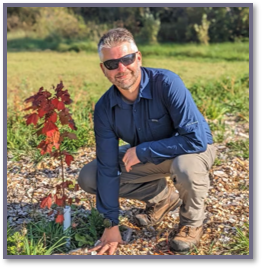
Simon Wilmot
Forest and Environmental Officer, City of Charlottetown
FCM's Sustainable Communities Conference: Discount tickets on sale now
Lessons from Charlottetown, PE, Mahone Bay, NS and Longueuil, QC on growing stronger, more resilient canopies
 TREES
Canadian municipal staff are working to champion urban forestry in their in their communities. After record-breaking storms, invasive pests, and decades of under-investment, three communities — Charlottetown, PEI, Mahone Bay, NS and Longueuil, QC — are rebuilding their urban forests with a mix of data, community engagement and creative planning.
Charlottetown is recovering from Hurricane Fiona. Mahone Bay is shifting from decades of reactive tree care to proactive management. Longueuil is responding to urbanization, heat islands and major ash tree loss. However, the lesson is shared: before communities can grow their canopy, they need to understand what they have, what they have lost and where new trees can do the most good.
Simon Wilmot
Forest and Environmental Officer, City of Charlottetown

Lauren Clark
Climate and Energy Program Manager, Town of Mahone Bay

Alexandre Fichon
Environmental Analyst, City of Longueuil
For Charlottetown, an urban forest strategy was critical after a natural disaster.
Simon Wilmot, Forestry and Environmental Officer with the City of Charlottetown, says Hurricane Fiona, the most powerful recorded hurricane to hit the Atlantic Channel, forced the city to look closely at the scale of its tree loss.
The numbers were stark: the canopy dropped from about 20.9 per cent to 17.6 per cent, representing an estimated loss of roughly 12,600 mature trees. “We will never know how many trees are lost on private properties,” Wilmot explains.
Replacing those trees one-for-one was not enough. “If we just planted 12,600, it would take 5,000 years to get back to the same level of canopy cover, and I’m impatient,” he says.
The city instead looked at what it would take to restore the canopy within 10 years. The answer was about 84,000 trees — a “mindboggling” figure, Wilmot says, given that the city had previously planted about 1,000 trees a year.
Charlottetown is now focused on concentrated, visible planting. Rather than spreading individual trees thinly across the city, Wilmot says clustered projects can create change residents notice. “It’s better to plant 10 trees in one park than 10 trees in 10 different parks,” he says.
Aesthetics matter, too. Charlottetown is experimenting with dense plantings of mixed flowering trees and shrubs. “I’m all for planting small trees, but it takes a long time for them to grow,” Wilmot says. It can be hard to get a community to “invest in something that we’re only going to appreciate in 30, 40 years.”, so it’s helpful to plant a variety of tree species.
Lauren Clark is the Climate and Energy Program Manager with the Town of Mahone Bay, located on the southern shore of Nova Scotia with just over 1,000 residents. Clark says that the town had not consistently planted street trees since the 1960s. “The urban canopy really has been left for many years, which is obvious when you look around,” she says.
That began to change with the town’s 2019 centennial project, ‘100 Years, 100 Trees’, when trees were planted within the urban centre, in parks and public gardens. During this time, the idea of an urban forest management plan came up with the local council.
The first step in that plan was inventory. In 2022, an intern mapped street trees. In 2023, another student refined the data and invited residents to add private trees through a management software called TreePlotter. Clark also rallied the community together, organizing weekly walks to improve tree data in different parts of town.
By the end of the summer, Mahone Bay had added nearly 3,000 trees to its inventory. The town is now dividing itself into sectors so every street tree can be assessed and pruned once every seven years. Its vision includes no net loss of trees, sustainable management, wildlife preservation and recognition of the urban forest’s value.
Another aspect of the urban forest management plan is to move from reactive to proactive tree care. “I’m pleased to say that the city is moving towards this goal,” she says.
As a major suburb of Montreal, Longueuil is working at a different scale. Home to about 250,000 residents and roughly 70,000 public trees, the city sits in a region where natural areas make up about 27 per cent of the territory, and are under growing development pressure. In recent years, Longueuil has also faced significant canopy loss, including from emerald ash borer infestations.
The city’s response is ambitious: a greening plan layered onto its existing tree policy, natural areas plan and climate plan. Using detailed mapping, Longueuil is identifying its tree canopy cover and where paved surfaces and vulnerable populations overlap to signal where intervention is most urgent: schools, hospitals and neighbourhoods facing social or economic challenges.
In collaboration with public, private and community partners, the city’s target is to plant 125,000 trees by 2040, which would mean an urban canopy cover of 30 per cent. “You really have to keep [trees] going as long as possible,” says Alexandre Fichon, Environmental Analyst at the City of Longueuil. “A tree should last between 20 and 50 years,” he says.
Fichon is clear-eyed about what it will take to get there, warning against setting goals that are too ambitious to reach, while also encouraging community partnerships and knowledge-sharing: “don’t hesitate to ask questions,” he says. “You may find that [you] obtain data that you wouldn’t normally have.”
From Prince Edward Island to Nova Scotia to Quebec, the message is the same: resilient urban forests are not built by planting alone. They are built through better data, visible projects, community trust and the capacity to care for trees long after they go in the ground.
This article shares key takeaways from “Urban Forestry for Every Community,” a past webinar hosted by GMF.


The Green Municipal Fund's Growing Canada’s Community Canopies is a $291 million initiative, ending in 2031, funded by the Government of Canada and delivered by the Federation of Canadian Municipalities. Capacity building is enabled through a partnership with Tree Canada. GCCC will support the planting of at least 1.2M trees across Canada by end of March 2031.
Learn how communities of all sizes can be leaders in urban forestry
Read moreLearn how to plan and manage your community’s urban forest.
Read moreLearn how to integrate inclusive engagement strategies into urban forestry
Read moreWhat municipal leaders and experts say makes a plan practical, resilient and community-driven
Read more Municipal buildings